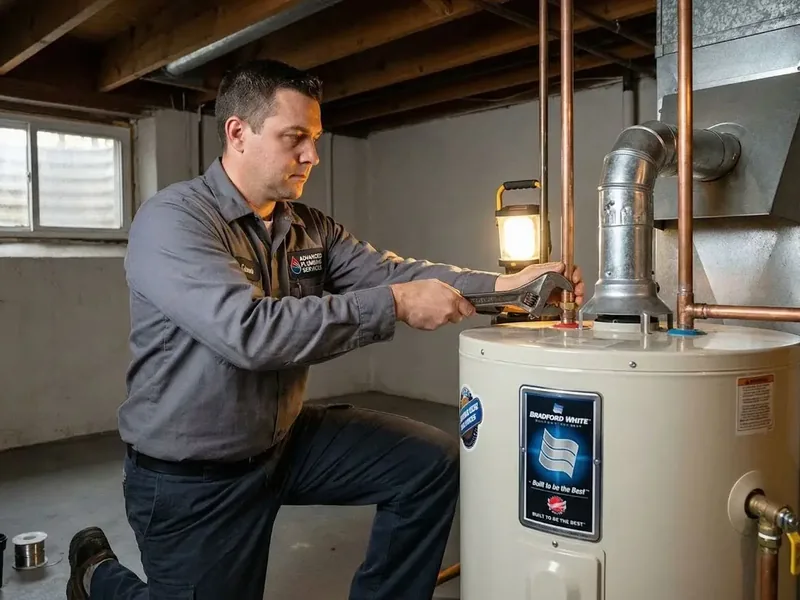
Well Water vs. the Lower Thermostat: An Unfair Fight
The lower thermostat sits inches above the tank bottom — exactly where Berkley's well water deposits its load. Iron, manganese, sand, and silt settle continuously, and in a well-water tank the sediment blanket grows far faster than in a town-water tank. Once it buries the lower element and reaches the lower thermostat, the unfair fight begins: the thermostat can no longer sense the bulk water temperature. Instead it reads the superheated pocket trapped around the element under the sediment. It cuts power early, then late, then erratically — thermal chaos that pits its contacts, degrades its sensor, and overheats the element it controls. The upper thermostat, sitting high in cleaner water, often survives fine while the lower one dies years early.
This is why the classic Berkley symptom is the shrinking shower: hot water for a few minutes (the upper section, still working) then cold (the lower bulk, never heated because its thermostat failed under sediment). Homeowners sometimes blame the well pump or pressure tank; the real culprit is under inches of mineral blanket at the tank bottom. When we open a Berkley tank and find the lower thermostat entombed, the diagnosis writes itself — and so does the prevention.
Acidic Water and Electrical Components: The Second Assault
Berkley's wells do not just bring sediment; many run acidic, and acidic water attacks from a different direction. Low-pH water is more corrosive to metals throughout the system — including the thermostat terminals, wire connections, and element surfaces behind the access panels. Corroded terminals increase electrical resistance, which generates heat at the connection, which further degrades the terminal: a slow feedback loop that ends in scorched connections and failed components. We open Berkley access panels to find green-corroded terminals and brittle wire insulation more often than in town-water homes.
The defense is water treatment, not just parts. An acid-neutralizing filter ahead of the water heater protects the thermostats' electrical connections, the elements, and every copper pipe and fixture in the house. It is the single highest-value addition for an acidic-well home, and we discuss it during every Berkley thermostat visit — not as an upsell, but as the environmental fix the new parts need. A replacement thermostat installed into the same corrosive conditions without treatment is a countdown, not a cure. When you call (833) 713-2101, mention if your well is acidic; it shapes the whole visit.
Symptoms: Reading What the Tank Is Telling You
No hot water at all, breaker untripped: the upper thermostat failed or the ECO high-limit tripped — on a well-water tank, check whether the ECO tripped from genuine overheating (sediment-driven) before assuming the thermostat died. Hot water for minutes then cold: the lower thermostat or lower element, buried in sediment — Berkley's signature failure. Scalding water: a thermostat stuck closed — take it seriously and call (833) 713-2101 promptly, since scalding is a burn hazard and the overheating stresses the tank. Lukewarm water that never satisfies: a thermostat misreading due to sediment insulation or corrosion. Breaker tripping: a shorted component, possibly from moisture or corroded connections.
One Berkley-specific note: power outages. Well homes lose water pressure when the power fails (the pump stops), and the water heater sits full but unheated. When power returns, the heater runs a long recovery cycle — and a marginal thermostat that was coping can fail under the sustained demand. If your hot-water problems started right after an outage, mention it; the timing is diagnostically meaningful. And never run hot water during an outage to 'use it up' — the tank needs its water when power returns.
Our Diagnostic Process on Well-Water Tanks
Berkley diagnosis starts before we touch the heater: we ask about the well — filtration equipment, water acidity, sediment history, recent pump work — because the water predicts the failure. Then the standard discipline with well-water emphasis. Symptom history and tap-temperature check. Power off at the breaker, verified dead. Panels and insulation off; we expect and look for the well-water signatures: sediment depth at the drain valve, corrosion on terminals, moisture behind panels, scorched connections. Each thermostat multimeter-tested for switching and continuity; elements tested for resistance and ground faults — on sediment-buried lowers, we often find both thermostat and element failed together. ECO state noted. Tank assessed overall: a thermostat replacement on a tank whose steel is failing is poor advice, and well-water tanks can corrode faster, so we check honestly.
Critically, we assess the sediment load itself — running water from the drain valve to gauge it — because the replacement plan depends on it. A light sediment load means flush and replace. A tank buried deep means a serious flush, possibly multiple, and a frank discussion about whether the tank's remaining life justifies the investment versus replacement. You will hear the full picture before we quote anything.
Replacement Paired With the Real Fix
The replacement procedure is methodical: wires labeled, old thermostats unclipped, matched new units installed — we nearly always replace the pair on well-water tanks, since the upper has endured the same corrosive environment — connections secured to spec, panels and insulation restored, both set to 120 degrees, tank confirmed full before power returns, then full verification of heating sequence and shutoff.
But the procedure's second half is what makes it last in Berkley: the sediment flush. We drain and flush the tank to carry out the accumulated blanket, repeating until the water runs clear. Where the drain valve is clogged with sediment (common), we work it clear or replace the valve itself. And we lay out the ongoing plan: annual flushing at minimum for well-water tanks, sediment pre-filter installation to reduce incoming load, neutralizing filtration for acidic wells. The new thermostats go into a clean tank with a maintenance plan — that is the difference between a repair that lasts two years and one that lasts ten. Skipping the flush to save a few minutes is the false economy we will not offer.
Filtration, Flushing, and the Maintenance Calendar
For Berkley well-water heaters, the calendar is non-negotiable. Quarterly: check the sediment pre-filter cartridge — you will quickly learn your well's loading rate. Annually: full tank flush, thermostat function check (tap temperature vs. setting), ECO verification, access-panel inspection for moisture and corrosion. Every few years: anode rod inspection, since well water consumes anodes faster and the rod is the tank's main defense. Neutralizing filter media on its schedule for acidic wells. Keep the mechanical area dry; in Berkley's damper basements, a dehumidifier protects the new terminals.
Watch for the early warnings between services: showers shortening (sediment rebuilding), water temperature drifting from the setting (thermostat struggling), the ECO tripping even once (overheating event). Each is a call-(833) 713-2101 signal while the fix is still small. Berkley homeowners who follow this calendar stop replacing thermostats every few years; those who do not, do. The well is the environment — manage it, and the equipment follows.
What Happens When You Call (833) 713-2101
Call the Water Heater Leak Repair Crew from Berkley and lead with the well: filtration, acidity, sediment history, and the hot-water symptom. We will ask whether the heater is electric or gas, its age, and how the well equipment has been behaving. Hot-water loss and scalding get priority. On arrival we diagnose the full picture — symptom, components, sediment load, water conditions, tank health — and explain the failure and the fix together, including the flushing and filtration the repair needs to last. Most thermostat replacements complete in one visit; where the tank itself is failing, you will hear that honestly instead of a parts sale. We verify heating sequence, setpoint shutoff, and tap temperature before leaving. One call to (833) 713-2101 gives your Berkley water heater a repair designed for well water, not just a parts swap.