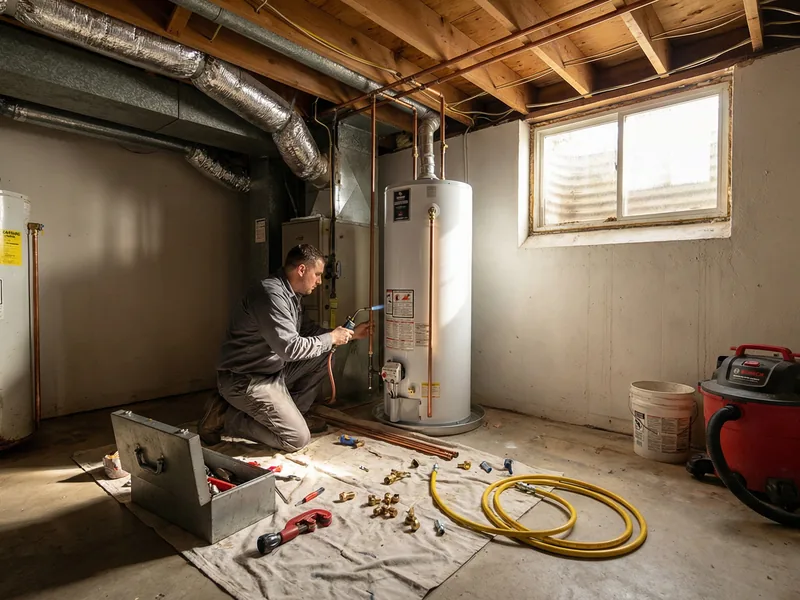
Old Pipes, Old Panels, Old Basements: Blackstone's Triple Threat
A water heater thermostat in Blackstone contends with the building around it. First, the pipes: mill-era homes still carry sections of original galvanized or early copper piping that shed sediment and scale into the tank. That sediment blankets the bottom, buries the lower element, and insulates the lower thermostat from the water — the classic short-shower failure, arriving years earlier than in a newer-piped home. Second, the electrical panel: many Blackstone homes still run on panels and wiring installed decades ago, with loose connections and voltage fluctuation that pit thermostat contacts through micro-arcing. A thermostat's switch cycles thousands of times a year; dirty power shortens that life measurably. Third, the basement: fieldstone and early-concrete foundations in the old housing stock wick moisture, and damp air behind the access panels corrodes terminals and degrades wire insulation.
Individually each is manageable; together they explain why Blackstone thermostats fail younger than their rated life. Our diagnosis therefore inspects all three environments — sediment load via the drain valve, electrical supply quality at the connections, moisture behind the panels — because replacing the thermostat without noting the conditions is an incomplete job. When you call (833) 713-2101, the building's age is diagnostically useful information.
How the Two-Thermostat System Fails
Electric tanks use the sequential two-thermostat design: the upper thermostat (with the ECO high-limit safety) heats the tank top first through the upper element, then hands power to the lower thermostat for the main volume. Gas tanks use a combination gas control valve with integrated thermostat. Each failure has its signature. Upper thermostat or ECO failure: no hot water at all. Lower thermostat or element failure: a few hot minutes then cold — the tank top heats, the bulk never does. Stuck-closed thermostat: scalding water at every tap, a burn hazard demanding prompt attention at (833) 713-2101. Miscalibrated thermostat: persistently lukewarm water. Shorted component: a tripping breaker.
In Blackstone's multifamilies, learn the building-level symptoms: one unit's complaint may be the thermostat, but every unit complaining at once points to the shared tank's lower system. And a scalding complaint from any tenant should trigger same-day attention — one stuck thermostat can endanger a whole building, and the liability sits with the property owner. We prioritize scalding and total-loss calls from rental properties for exactly this reason.
The Rental Delay: Why Blackstone Failures Get Discovered Late
Blackstone's substantial rental stock in the old multifamily buildings creates a reporting gap that turns small thermostat failures into big ones. A homeowner notices the shower shortening within days; a tenant may tolerate it for weeks before complaining, and a landlord may not hear about it until it becomes no-hot-water. By then, the failed lower thermostat has often taken the lower element with it — sediment-buried and overheated for months — turning a thermostat swap into a thermostat-plus-element job, sometimes with a tank assessment that reveals deeper decline.
Landlords can close this gap inexpensively. Add water-heater temperature to the routine property check: once or twice a year, verify tap hot water is around 120 degrees and ask tenants directly about hot-water behavior — short supply, scalding spikes, odd noises. Treat complaints as priority maintenance, not someday items. Ensure the heater remains accessible; in old multifamilies the basement mechanical corner tends to accumulate storage that blocks the access panels. And keep our number: (833) 713-2101. We work with Blackstone property owners regularly — plain diagnosis, clear options, scheduling that respects tenants. The landlords whose buildings never lose hot water are the ones who check before tenants complain.
Diagnosis: Testing, Not Guessing
Thermostat symptoms overlap with element and wiring failures, so we test rather than guess. The visit: symptom history, tap-temperature measurement, power off at the breaker and verified dead with a meter. Panels and insulation removed; visual inspection for Blackstone's signatures — sediment depth, scorched or corroded terminals, moisture, damaged insulation. Multimeter testing of each thermostat for continuity and switching; elements tested for resistance and ground faults; ECO state checked. Electrical connections inspected for the looseness and corrosion that old panels produce. Tank assessed overall — age, exterior, leaks — because a thermostat replacement on a failing tank is the wrong recommendation.
This discipline matters most where the failure ran long, as in rentals: a lower thermostat dead for months often means a dead lower element too, and only testing reveals the full scope before we quote. You will hear exactly what failed, what it takes to fix, and what the tank's condition suggests about the future — diagnosis first, quotation second, no parts sold on assumption.
Replacement Done Right in Old Buildings
Replacement in a Blackstone old-timer follows the careful procedure: wires photographed or labeled before disconnection (old wiring colors fade and previous work may not follow convention), failed units unclipped, matched new thermostats installed — we replace the pair on older tanks, since the survivor endured the same sediment, moisture, and electrical wear — connections torqued to spec with corroded terminals cleaned or renewed, insulation and panels restored. Both thermostats set to 120 degrees. Tank confirmed full before power restoration. Full verification: heating sequence correct, shutoff clean at setpoint, tap temperature stable.
The old-building extras: we tighten and inspect the electrical connections we can reach, noting panel issues beyond our scope honestly. We flush sediment as part of the job — on old-pipe homes the blanket is often substantial — and where the drain valve is sediment-fused, we address it. We note moisture conditions behind the panels and advise on the dehumidification or drainage that protects the new components. And we leave the symptom decoder with whoever manages the building, so the next failure gets reported at the first sign instead of the last. Gas units get the combination gas control valve replaced with proper gas procedure and leak testing.
Keeping Hot Water Reliable in Blackstone Buildings
The maintenance calendar for Blackstone's old buildings: annual tank flushing (old pipes reload sediment continuously), tap-temperature verification once or twice a year (catches miscalibration early), access-panel inspection for moisture and terminal corrosion, electrical connection checks where accessible. For rentals, fold the temperature check into the regular property walkthrough and ask tenants about hot-water behavior directly — the question costs nothing and catches failures months earlier. Keep the mechanical area clear and dry; in stone basements, a dehumidifier is cheap protection for terminals and wiring.
The deeper fix, where feasible, is addressing the environments: repiping the worst galvanized sections reduces the sediment load at its source; panel and wiring upgrades stabilize the voltage that pits contacts; basement moisture management protects everything electrical. These are larger projects, but each extends the life of every component in the building — thermostats included. We will tell you honestly which environmental factors are driving your failures when you call (833) 713-2101, so your maintenance money goes where it matters.
What Happens When You Call (833) 713-2101
Call the Water Heater Leak Repair Crew from Blackstone and describe the symptom and the building — no hot water, short showers, scalding, tripped breaker; single-family or multifamily; heater electric or gas; approximate age. Landlords: tell us it is a rental and how many units the tank serves. Hot-water loss and scalding get priority, especially in multifamily buildings. On arrival we diagnose completely — symptom, components, sediment, electrical, moisture, tank health — and explain the failure plainly before any replacement is discussed. Most thermostat jobs finish in one visit with the pair set to 120 degrees and verified. You will also hear our honest read on the tank and the building factors affecting it. One call to (833) 713-2101 restores reliable hot water to Blackstone's old buildings.