Two Water Sources, Two Thermostat Life Expectancies
A Dighton water heater's thermostat lifespan is largely written by its water source. District-water tanks follow the familiar suburban pattern: sediment accumulates gradually, the lower thermostat works correctly for a decade or more, and failure eventually comes from contact wear, age, or a long-neglected flush. Well-water tanks live faster: iron, manganese, and sediment settle aggressively, burying the lower element and thermostat in a mineral blanket that insulates the sensor from the water. The thermostat misreads, cycles erratically, overheats — and fails years ahead of its district-water twin. Acidic wells add terminal corrosion to the assault.
The practical meaning: when a Dighton homeowner reports shrinking showers, our first question is the water source, because it predicts both the failure and the fix. A district-water tank with a failed lower thermostat at year twelve gets tested components, replacement, and a flushing reminder. A well-water tank with the same symptom at year seven gets the same replacement plus a serious flush, a sediment-filter discussion, and a maintenance calendar — because without addressing the water, the new thermostat inherits the old one's fate. Tell us your water source when you call (833) 713-2101; it is the most useful fact of the visit.
How Thermostats Fail: The Component Story
Electric tanks run the sequential two-thermostat system: the upper thermostat (carrying the ECO high-limit safety) heats the tank top via the upper element, then passes power to the lower thermostat for the main volume. Gas tanks use a combination gas control valve with integrated thermostat. The failure signatures: no hot water at all means the upper thermostat failed or the ECO tripped. A few hot minutes then cold means the lower thermostat or lower element failed — Dighton's signature well-water failure. Scalding water means a thermostat stuck closed — call (833) 713-2101 promptly, as scalding is a burn hazard and the overheating stresses the tank. Lukewarm always means a misreading thermostat. A tripping breaker means a shorted component.
Sediment is the usual murder weapon on well-water tanks: the buried lower thermostat senses the superheated pocket around the element rather than the tank water, cycling destructively until contacts pit and the sensor degrades. Often the lower element dies with it, overheated under its own blanket. On district-water tanks, plain age and contact wear lead — thousands of cycles pitting the switch until it fails to conduct or fails to break. Corrosion from damp outbuilding installations contributes in both worlds. Testing, not guessing, identifies which component failed — we multimeter-test thermostats and elements independently before recommending anything.
Outbuildings, Cold, and the Winter Thermostat
Dighton's large lots put water heaters in detached garages, barn workshops, and outbuildings more often than suburban towns do — and cold changes the thermostat's working conditions. Cold incoming water in winter forces longer, harder heating cycles, accelerating contact wear. Condensation on cold tank surfaces corrodes terminals behind the access panels. In unheated outbuildings, the tank loses heat faster between cycles, increasing cycle count. None of this breaks a healthy thermostat outright, but it shortens the life of a marginal one — which is why Dighton outbuilding heaters often fail in February rather than July.
The more dramatic winter risk is the power outage: well pumps stop, water pressure vanishes, and the heater sits full and idle. When power returns, the recovery cycle is long and demanding — a stressed thermostat can fail under it. After any winter outage, check hot-water behavior; problems starting right then point to the recovery cycle as the trigger. For outbuilding heaters, fall preparation matters: verify the space stays above freezing (a frozen tank is a far worse problem than a failed thermostat), insulate exposed piping, and keep the access panels' area dry. If your outbuilding heater's hot water failed after a cold snap or outage, call (833) 713-2101 and mention the timing.
Our Diagnostic and Replacement Process
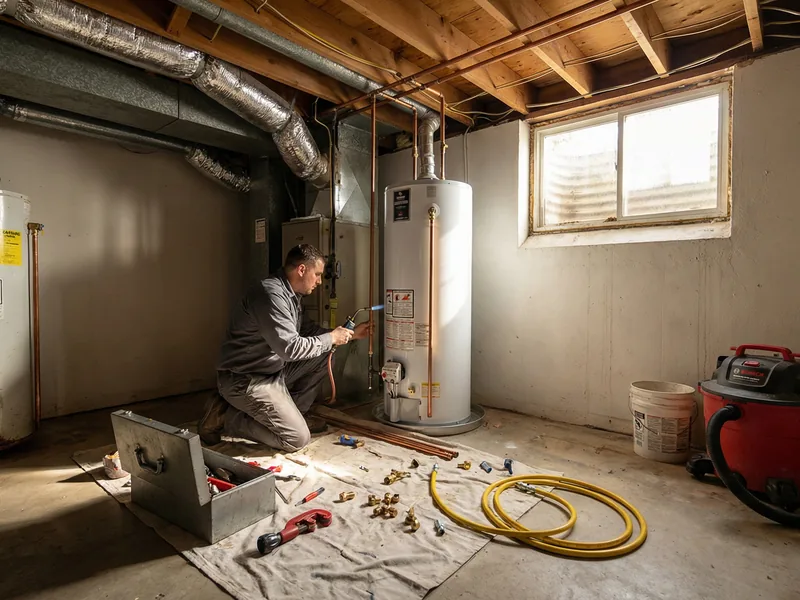
Every Dighton visit opens with the water source and the heater's location — well or district, basement or outbuilding — because those facts order the diagnosis. Then: symptom history, tap-temperature check, power off at the breaker and verified dead, panels and insulation off. Visual inspection for the signatures matching the water: sediment depth and terminal corrosion on well-water tanks, age-related wear on district tanks, moisture in outbuilding installs. Multimeter testing of both thermostats for switching and continuity; elements tested for resistance and grounds — on sediment-buried lowers we frequently find thermostat and element failed together. ECO state noted. Tank health assessed: age, exterior, leaks — thermostat replacement on a dying tank is the wrong call, and we say so.
Replacement is methodical: wires labeled, old units unclipped, matched new thermostats installed — the pair, on well-water tanks, without exception; the upper endured the same water — connections torqued, panels restored, both set to 120 degrees, tank confirmed full before power returns. Then the well-water essential: the flush. We drain and flush until clear, working sediment-fused drain valves as needed. Verification closes the job: correct heating sequence, clean shutoff at setpoint, stable tap temperature. Gas units get the control valve replaced with proper gas procedure and leak testing. Diagnosis first, quotation second, flush always on well water.
Flushing and Filtration: The Dighton Difference
Here is what separates a lasting Dighton thermostat replacement from a repeat: the water gets treated, not just the component. The flush performed during replacement clears the accumulated blanket — and on well-water tanks neglected for years, the volume of sediment is often startling. But a single flush is a reset, not a solution; without ongoing maintenance, the blanket rebuilds. The calendar: annual flushing minimum for well-water tanks (twice-yearly for heavy-sediment wells until filtration is installed), every two to three years for district-water tanks. Sediment pre-filter on the cold inlet for well homes — the cartridge catches the load before the tank does, and quarterly checks quickly reveal your well's rate. Neutralizing filtration for acidic wells, protecting terminals and piping.
We install pre-filters during the replacement visit — the plumbing is accessible and it is the highest-value addition for a well-water heater. The new thermostats then operate in a managed environment instead of a sediment tomb, and their lifespan reflects it. Dighton homeowners who adopt the routine stop calling about thermostats; those who treat the replacement as the whole fix call again. When you call (833) 713-2101, ask about the filtration options for your water — we will recommend based on what your well actually carries.
Reading Early Warnings Between Services
Thermostats rarely fail without announcing it — the announcements are just easy to dismiss. Showers gradually shortening: sediment rebuilding and the lower thermostat struggling. Water temperature drifting from the 120-degree setting: the thermostat misreading. The ECO tripping even once: an overheating event occurred — find out why. Rumbling or crackling from the tank (kettling): heavy sediment boiling around the lower element, the thermostat's neighborhood under stress. Rusty or gritty water from the drain valve: sediment load high.
Each of these is a call-(833) 713-2101 signal while the repair is still small. A thermostat caught at the shortening-shower stage is a clean replacement with a flush; one left until it destroys the element and the ECO is tripping is a bigger job with more parts. This is doubly true on well water, where the progression runs faster. Put a simple habit in place: notice your hot water. The households that do, spend less on water heaters than the households that do not — in Dighton, that difference is measured in years of component life.
What Happens When You Call (833) 713-2101
Call the Water Heater Leak Repair Crew from Dighton and lead with the water source — well or district — the heater's location, and the symptom. We will ask electric or gas, approximate age, filtration equipment, and well behavior if applicable. Hot-water loss and scalding get priority. On arrival we diagnose the complete picture: symptom, components, sediment load, water conditions, tank health — and explain the failure and the fix together, including the flushing and filtration the repair needs to endure. Most replacements finish in one visit with the pair set to 120 degrees and verified; where the tank itself is failing, you will hear that honestly. One call to (833) 713-2101 gives your Dighton water heater a thermostat repair built for its water, its placement, and its winters.