Historic Homes: Sediment, Old Wiring, and Stone Basements
Easton's 19th-century farmhouses and Victorians give thermostats a historically-flavored hard life. The piping in these homes — sections of it sometimes original — sheds sediment and scale into the tank continuously, building the bottom blanket that buries lower elements and insulates lower thermostats from the water they must sense. The result is the classic shrinking shower arriving years early, often with the lower element cooked to death alongside the thermostat. The electrical systems, updated piecemeal across decades, may deliver the fluctuating voltage and loose connections that pit thermostat contacts through arcing. And the stone foundations keep basements damp; moisture behind the access panels corrodes terminals and degrades wire insulation, adding electrical failure to the sediment failure.
When we open an Easton historic-home heater, we inspect all three environments as a matter of course: sediment depth at the drain valve, terminal and connection condition, moisture behind the panels. The thermostat replacement then comes with the environmental work — a thorough flush, connection cleaning and torquing, moisture advice — because the new parts deserve better conditions than the old ones got. A swap without the flush in these homes is a two-year repair; with it, a ten-year one. The house is always part of the diagnosis in Easton's historic stock.
Subdivisions: The Honest Age-and-Neglect Timeline
Easton's newer subdivisions tell a simpler, more forgiving story. Builder-grade electric tanks went in with the houses, worked well for years, and are now reaching the age — typically ten to fifteen years — where thermostats fail from straightforward causes: contact wear from thousands of cycles, sediment accumulated through a decade of never being flushed, the occasional damp mechanical room. The failure pattern is the textbook one: lower thermostat first (sediment's victim), upper later, ECO trips as the warning flare.
The good news for subdivision owners is that these are clean repairs on generally sound tanks. The installations are standard, access is good, parts are standard, and the tank steel usually has years left — making thermostat replacement the clear right call over a new heater. Our visit follows the full diagnostic discipline anyway (testing, not guessing), because even in straightforward settings an element can be the real culprit. After replacement — pair, 120 degrees, verified — the maintenance calendar is simple: flush every two to three years, monthly awareness of hot-water behavior, and the symptom decoder so the next issue gets caught early. The builder gave you a decent tank; a little attention now pays back for years.
How Thermostats Fail: Symptoms and Their Meanings
The two-thermostat electric system — upper with ECO high-limit heating the top first, lower heating the bulk; gas tanks using a combination control valve — produces distinct signatures. No hot water at all: upper thermostat failed or ECO tripped. Hot minutes then cold: lower thermostat or lower element — Easton's most common failure in both housing worlds, sediment-driven in historic homes and age-driven in subdivisions. Scalding water: stuck-closed thermostat — call (833) 713-2101 promptly; scalding is a burn hazard, especially with children or older adults in the home, and the overheating stresses the tank. Persistently lukewarm: miscalibrated or misreading thermostat. Tripping breaker: shorted component.
In Easton's historic multifamily conversions, treat scalding as a building-level emergency — one stuck thermostat can endanger multiple households. And note the ECO's message: a tripped high-limit means the water got dangerously hot. Resetting it once to confirm is reasonable; resetting it repeatedly while the fault continues is asking the tank to overheat. The ECO is the fire alarm; our job is finding the fire.
Stone Basements and the Moisture Problem
Easton's fieldstone foundations deserve their own section because they shape failures so distinctly. Stone is porous and uneven; the basements stay humid, and in high-water-table seasons, actively damp. For the water heater's thermostats, that humidity works behind the access panels: terminals corrode, wire insulation degrades, connections loosen through corrosion-assisted creep. We find green-corroded terminals in Easton stone basements far more often than in dry poured-concrete ones. The moisture also hides leaks — a slow tank weep wicks into the stone and spreads as general dampness rather than a visible puddle, so the tank's decline goes unnoticed.
Our stone-basement protocol: thorough terminal and wiring inspection with corrosion cleaned and compromised connections renewed; moisture noted and discussed honestly — a dehumidifier near the mechanical area is inexpensive protection for the new components; and the tank's exterior checked carefully for the weeps that dampness hides. The thermostat replacement protects the electrics; the environmental advice protects the replacement. If your Easton stone basement always feels damp, that is the environment — and the new thermostats need it managed to live their full life.
Our Diagnostic and Replacement Process
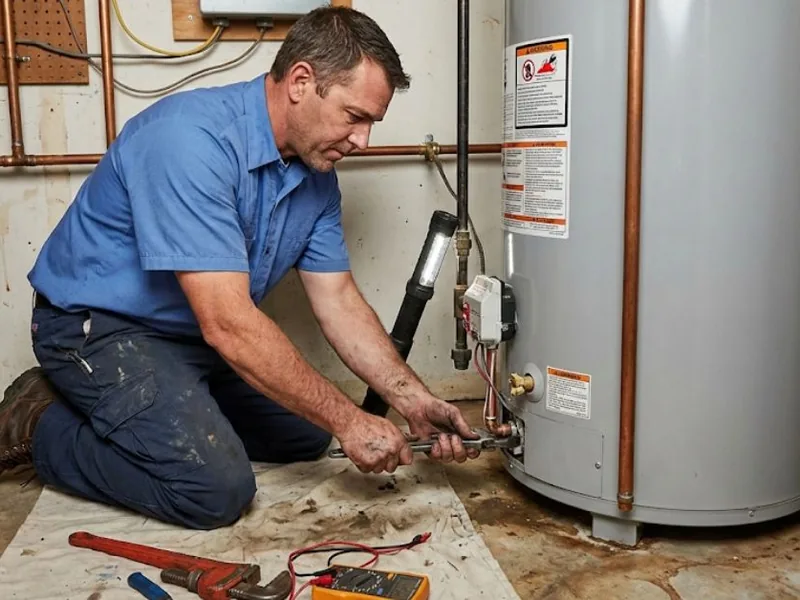
Diagnosis before replacement, every time, in both housing worlds. Symptom history and tap-temperature check. Power off at the breaker, verified dead with a meter — 240 volts gets no assumptions. Panels and insulation off; visual inspection for the signatures: sediment depth, terminal corrosion and scorching, moisture, component swelling. Multimeter testing of each thermostat for continuity and switching; elements tested for resistance and ground faults, since elements mimic thermostats and we do not replace the wrong part. ECO state noted. Tank assessed: age, exterior condition, leaks, water quality — because a thermostat replacement on a failing tank misspends your money, and we will recommend replacement when the tank warrants it.
The replacement: wires labeled or photographed (old-home wiring does not always follow modern color convention), old units unclipped, matched new thermostats installed — the pair on older tanks, where the survivor shared every hardship — connections torqued, panels and insulation restored, both set to 120 degrees, tank confirmed full before power returns. Verification: correct heating sequence, clean shutoff at setpoint, stable tap temperature through a cycle. Gas units: control valve replaced with proper gas procedure and leak testing. Then the environmental work — flush, connection care, moisture advice — matched to the house.
Maintenance Matched to the House
Historic homes: annual flushing (old pipes reload sediment relentlessly), terminal and connection inspection for corrosion, moisture management in the stone basement — dehumidifier, drainage attention — and electrical awareness: if the panel is original-era, have an electrician assess it, since stable voltage protects every component. Subdivisions: flushing every two to three years, the monthly hot-water awareness habit, neutralizer-free simplicity (town water here is kind), and the symptom decoder on the refrigerator: shortening showers, temperature drift, any ECO trip — each a call-(833) 713-2101 signal.
Both worlds: 120 degrees, always. Higher settings buy nothing but scald risk, faster sediment bake-on, and shorter component life. Keep the mechanical area clear and dry so panels stay accessible and drips stay visible. And when the tank itself approaches fifteen years — sooner if the water is hard on steel — start planning: a thermostat replacement at year fourteen should come with an honest conversation about the tank's remaining years, which we will have with you. Maintenance matched to the house is the whole game in Easton.
What Happens When You Call (833) 713-2101
Call the Water Heater Leak Repair Crew from Easton and describe the symptom, the heater (electric or gas, approximate age), and the house — historic or subdivision, stone basement or dry. Your answers tell us whether to expect the sediment-and-moisture pattern or the age-and-neglect one, and what to load. Hot-water loss and scalding get priority. On arrival we diagnose completely: symptom, components, sediment, electrical, moisture, tank health — then explain the failure and the fix, including the environmental work the repair needs. Most replacements finish in one visit with the pair set to 120 degrees and verified; where the tank is failing, you will hear that honestly. One call to (833) 713-2101 gives your Easton water heater — historic or modern — a thermostat repair fitted to its house.