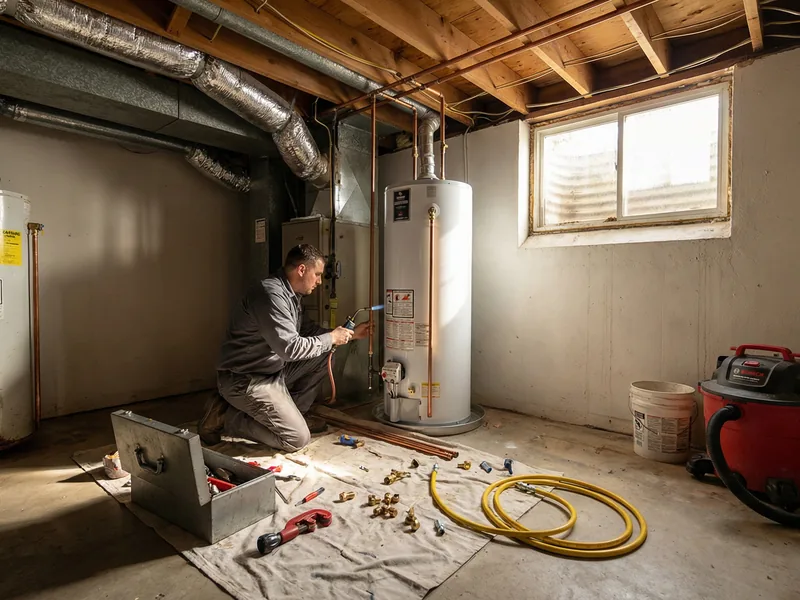
Test Before Replacing: Our Diagnostic Process
The classic thermostat mistake — DIY or otherwise — is replacing the thermostat when the element was the problem, or vice versa. A dead lower thermostat and a dead lower element produce the identical symptom: short hot-water supply. The only way to know which failed is electrical testing, and that is where every one of our Taunton thermostat calls begins.
The process: your symptom story first, then a tap-temperature measurement to confirm what the water is actually doing. Power off at the breaker, verified dead with a meter — non-negotiable. Access panels and insulation come off, exposing both thermostats for visual inspection: scorched terminals, corrosion, moisture, swollen or discolored components all get noted. Then the multimeter work: each thermostat tested for continuity and correct switching behavior as it heats and cools, each element tested for proper resistance and for shorts to ground. We also check the wiring connections, because a loose wire mimics a failed thermostat convincingly.
Only after testing names the failed component do we discuss replacement — and we show you the readings, not just the conclusion. If testing reveals the tank itself is failing — active leak, rusted base, fifteen-plus years — we say so honestly, because a new thermostat on a dying tank is money misspent. Taunton homeowners who call (833) 713-2101 get diagnosis first, parts second, always.
The Replacement: What Actually Happens
Once testing identifies the failed thermostat, the replacement itself is careful, methodical work. Wires are labeled or photographed before anything is disconnected — on a two-thermostat system, crossed wires create new problems. The old unit unclips from the tank wall; the new matched thermostat clips in flush, because a thermostat that does not sit flat against the tank cannot sense temperature accurately. Connections are secured and tightened to spec, insulation and access panels restored exactly as found.
On older tanks we usually replace the pair. The surviving thermostat is the same age, has endured the same cycles and the same sediment, and is rarely far behind — replacing one while the other fails six months later doubles the service calls. Both are set to 120 degrees. Then the critical step people forget: the tank must be confirmed completely full before power returns. An element fired in a partially drained tank — dry-firing — destroys itself in seconds. We verify fullness, restore power, and watch a complete heating cycle: correct sequence, clean shutoff at setpoint, stable temperature at the tap. Most Taunton thermostat replacements finish in a single visit, and the hot water is back the same day. Call (833) 713-2101 and describe the symptom; we will bring the matched parts.
Gas Units: The Control Valve Does It All
Gas water heaters consolidate the thermostat's job into a single combination gas control valve — the dial on the front of the unit. Inside it live the thermostat, the high-limit safety, and the gas regulation for the burner. When it fails, the symptoms rhyme with electric thermostat failure: no hot water, water too hot, or a pilot that will not stay lit because the valve no longer holds the thermocouple circuit.
Replacement is a gas-fitting job, not just an electrical one: gas supply shut off, the valve unthreaded from the tank, the new valve installed with proper thread sealant, gas connections leak-tested with a manometer or bubble solution, pilot lit and burner operation verified across a full cycle. It demands more care than an electric thermostat swap, and it is not a DIY project — gas connections done wrong leak. Taunton homeowners with gas units who call (833) 713-2101 get the valve replaced with full leak testing and combustion verification, the temperature set to a safe level, and the old valve's failure explained. Whether your heater burns gas or runs on electricity, the thermostat function gets the same test-first, verify-after discipline.
When a New Thermostat Is Not the Answer
Honesty requires saying this: sometimes the thermostat is not the real problem, and sometimes the tank is not worth saving. If testing shows both thermostats failed because the tank overheated from a grounded element, the element goes too. If the tank is fifteen years old with a rusting base and a weeping seam, new thermostats buy months, not years — and we will tell you that before spending your money. A thermostat replacement makes sense when the tank itself is sound: solid steel, no active leaks, reasonable age, and the failure isolated to the controls.
This is why our diagnosis always includes a tank assessment — visual check for leaks and rust, age from the rating plate, sediment evaluation during the flush. Taunton has plenty of heaters in the twelve-to-fifteen-year window where the call could go either way, and the assessment is what separates a wise repair from a wasted one. When you call (833) 713-2101, you get the full picture: what failed, why it failed, what the tank's condition means for the decision, and our plain recommendation. If the tank deserves new thermostats, we install them. If it deserves retirement, we say so and explain why.
Making the New Thermostats Last
The replacement is the midpoint of the job, not the end. New thermostats last longest in a tank that is maintained: flush annually to prevent the sediment burial that killed the old lower unit — twice a year on well water. Keep the setpoint at 120 degrees; higher settings accelerate contact wear, bake sediment harder onto the tank bottom, shorten element life, and raise scald risk for zero practical benefit in most households. Keep the mechanical area dry — moisture behind the access panels corrodes terminals, and a damp Taunton basement is the usual culprit. And have the electrical connections checked periodically, since loose wiring pits thermostat contacts through micro-arcing long before the thermostat itself would have worn out.
Learn the early warnings so the next failure gets caught at the symptom stage: showers gradually shortening, water hotter than the dial setting, the high-limit tripping even once. A thermostat replaced at the first symptom is a quick, clean, single-visit job; one left until it destroys the element costs more and risks the tank. After every Taunton replacement we leave homeowners with this checklist and a maintenance rhythm matched to their water source. Call (833) 713-2101 at the first sign of change and the fix stays simple.
What Happens When You Call {phone}
Call the Water Heater Leak Repair Crew from Taunton and describe the symptom — no hot water, short supply, scalding, lukewarm, tripped breaker or high-limit — plus whether the heater is electric or gas and roughly how old it is. Mention town water or well; it changes our maintenance advice and our suspicion about sediment. Hot-water loss and scalding get priority scheduling. On site we diagnose completely: symptom history, tap-temperature check, panel inspection, multimeter testing of thermostats and elements, wiring check, and a full tank condition assessment.
You hear the diagnosis before any replacement is discussed, with the test readings explained in plain language — and an honest read on whether the tank itself warrants the investment. Most jobs complete in one visit: failed parts replaced, both thermostats set to 120 degrees, tank confirmed full before power returns, and a full heating cycle verified at the tap. One call to (833) 713-2101 brings Taunton's hot water back to proper, safe working order — diagnosed first, fixed once, verified always.
How the Thermostat Governs Your Hot Water
An electric water heater carries two thermostats that work as a team. The upper thermostat holds priority: when the water at the top of the tank drops below the set temperature, it sends power to the upper heating element. Once the top is satisfied, it passes power down to the lower thermostat, which drives the lower element to heat the tank's main volume. Mounted on the upper thermostat is the high-limit switch — the ECO — a one-shot safety that cuts all power if the water overheats. Gas heaters compress this whole job into a single combination gas control valve with its own thermostat and high-limit built in.
This architecture is why symptoms are so diagnostic. No hot water at all usually means the upper thermostat failed or the ECO tripped — nothing is heating. A short burst of hot water followed by cold means the top heats but the bulk does not: the lower thermostat or lower element has quit. Water far hotter than the setting means a thermostat is stuck in the "heat" position. Lukewarm water that never gets properly hot suggests a thermostat cutting off early from a bad temperature reading. When you call (833) 713-2101 and describe exactly what the water is doing, you are giving us the first half of the diagnosis free of charge.