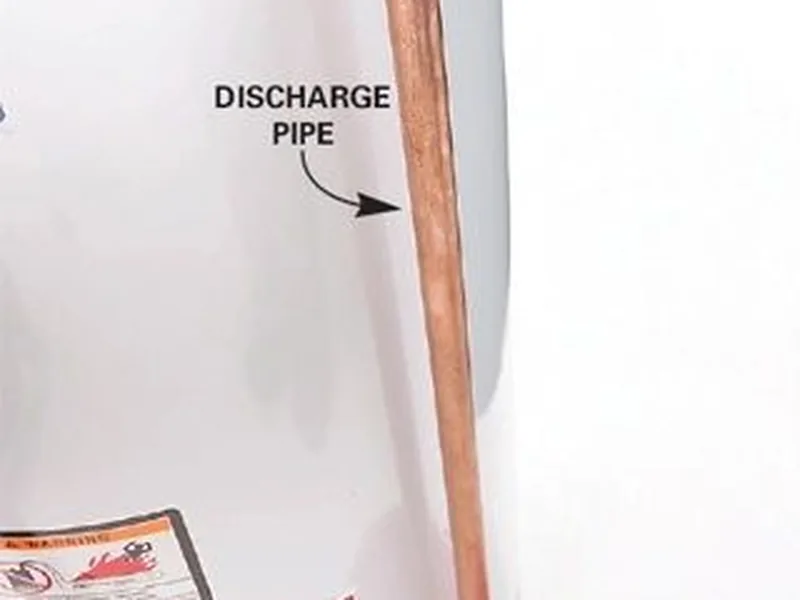
Discharge Piping: The Rules That Keep It Safe
The valve is only half the system; the discharge pipe is the other half, and Somerset homes show us every violation in the book. The rules exist for one reason: when the valve opens, scalding water must exit safely without endangering anyone. The pipe must be full-bore — the same diameter as the valve outlet, never reduced — because a restriction chokes the relief flow the valve was sized to deliver. It must run downward by gravity, with no traps or upward loops where water can sit and scale. It must terminate in a visible, safe location — typically 6 inches above the floor near a drain — never threaded, capped, or valved at the end, and never where discharge can spray onto a person or an electrical panel.
We regularly find discharge pipes that terminate inside walls, run uphill into crawlspaces, or were "temporarily" capped by a previous owner — each one defeats the safety device. As part of every Somerset TPR replacement, we bring the discharge piping into compliance: correct material (rated for hot water), correct routing, correct termination. It is not cosmetic work; a perfectly good new valve discharging through a capped pipe is no better than the failed valve it replaced. When you call (833) 713-2101, mention where your discharge pipe ends — if you cannot see it end, that alone warrants a look.
Dripping vs Gushing: Reading What the Valve Tells You
Not all TPR discharge means the same thing, and reading it correctly determines the urgency. A slow, steady drip or intermittent weeping is the common pattern — usually thermal expansion in a closed system, or a valve seat worn from years of exactly that. It is not an emergency tonight, but it is a service call this week: the valve is signaling chronic overpressure, and the seat is degrading with every cycle.
A full, forceful discharge that starts on its own is different — that is the valve doing its ultimate job against a genuine over-temperature or over-pressure event, most often a failed thermostat heating unchecked. Treat that as urgent: do not approach the discharge stream, note whether the water feels extremely hot, and call (833) 713-2101 promptly. And a valve that discharged once and now will not stop — the seat fouled by scale dislodged during the event — needs replacement regardless of what triggered it. Somerset homeowners sometimes ask whether they can just cap a weeping discharge pipe to stop the drip. Absolutely not — capping the pipe converts a warning into a sealed pressure vessel with no relief. The drip is the messenger; call (833) 713-2101 and we will address the message.
How Often Should a TPR Valve Be Replaced?
There is no calendar interval stamped on the valve, but practical guidance exists. Test annually with the lever test; replace at the first failed test — a lever that will not lift, a valve that will not open, or one that opens and will not reseat. Replace on visible deterioration: heavy mineral crusting, green corrosion on the brass, or a discharge pipe showing chronic weep stains. And consider proactive replacement on valves past ten to twelve years in Somerset's mineral water, especially if the valve has never been tested — an untested decade-old valve is a safety device of unknown condition, which is to say, not a safety device you can rely on.
We also recommend replacement whenever the water heater itself is replaced — a new tank deserves a new valve, full stop — and whenever system changes alter the pressure picture, such as installing a pressure-reducing valve or a backflow preventer that closes the system. Those changes are exactly what create the thermal expansion cycling that wears valves out. During every Somerset TPR service we note the valve's age from the heater's rating plate era and give you an honest read on its remaining trustworthiness. Call (833) 713-2101 for an assessment; this is the one component where "it seems fine" is not good enough.
High Water Pressure: The Valve's Other Enemy
Municipal water pressure varies street by street in Somerset, and where it runs high — above 80 psi — everything in the plumbing system suffers, the TPR valve included. High static pressure holds the valve's seat under constant load, accelerating wear; combined with thermal expansion spikes on top of an already-high baseline, the valve weeps chronically and its service life collapses. You may also notice the signs elsewhere: banging pipes, dripping faucets, a washing machine that hammers on fill, or a pressure gauge on a hose bib reading in the 90s or higher.
The fix for high inlet pressure is a pressure-reducing valve (PRV) on the main service, set to hold the house around 60 psi — but note the interaction: installing a PRV closes the system, which makes a thermal expansion tank necessary where one was not before. The three work as a system: PRV controls the baseline, expansion tank absorbs the heating-cycle spikes, TPR valve stands guard against true emergencies. When we replace a Somerset TPR valve and find high inlet pressure, we measure it, show you the reading, and explain the package — because a new valve on an uncorrected 95-psi system is a short-lived valve. Call (833) 713-2101 and we will check your pressure as part of the visit.
The {city} Housing Factor: Old Tanks, Old Valves
Somerset's housing stock shapes its TPR valve problems in a specific way. In the town's older homes — and Somerset has many — water heaters often sit in the same basement location through two or three tank generations, with the relief valve and discharge piping inherited, adapted, or improvised each time. We find valves threaded into corroded tappings, discharge pipes reduced to fit an old hole in the foundation wall, terminations buried behind finished basement walls added long after the heater. Each generation's shortcuts compound.
There is also the untouched-valve phenomenon: in homes where the heater "has always worked fine," the TPR valve may not have been tested or even looked at in fifteen years. Mineral does its slow work undisturbed, and the valve becomes a decorative brass fitting rather than a safety device. Our Somerset TPR visits therefore include a full survey of the installation's history — the valve, the piping, the tapping, the system pressure, the expansion situation — not just the part swap. A new valve on a compromised installation is half a job. When you call (833) 713-2101, you get the whole safety system brought up to trustworthy condition, whatever the basement's history.
What Happens When You Call {phone}
Call the Water Heater Leak Repair Crew from Somerset and describe what you are seeing — a dripping discharge pipe, a corroded or frozen valve, a failed lever test, or simply a valve of unknown age on an old heater. Active full discharge and weeping valves get priority scheduling, because this is safety equipment. On arrival we assess the complete relief system: the valve's condition and test response, the discharge piping route and termination, the tank tapping, system static pressure, and whether thermal expansion is stressing the valve.
You will hear the findings before any work begins — what failed, why it failed, and whether expansion or pressure issues need correcting alongside the valve. Most replacements finish in one visit: new matched valve, code-compliant discharge piping, system pressure checked, expansion tank added where the plumbing is closed, and the new valve lever-tested to prove it opens and reseats. One call to (833) 713-2101 restores Somerset's most important water heater safety device to full, verified working order.
What the TPR Valve Does — and Why It Is Non-Negotiable
A water heater is a pressure vessel. Heat water in a sealed steel tank and two things happen: the water expands as it warms, raising pressure, and if the thermostat ever fails and heating continues unchecked, the water can flash toward steam — expanding roughly 1,700 times in volume. A tank with no escape route for that pressure does not politely leak; it ruptures with explosive force. The famous demonstrations of water heaters launching through structures exist because the physics is real.
The temperature-pressure relief valve is the engineered escape route. It is set to open at 150 psi or 210 degrees — well above normal operating conditions, well below the tank's failure point. When either threshold is crossed, the spring-loaded valve lifts and vents water (and pressure) through the discharge pipe until conditions normalize, then reseats. Every water heater in Somerset is required to have one, and every one of them depends on a valve that actually opens when called upon. A corroded-shut or scaled-over TPR valve is not a minor defect — it removes the tank's last line of defense. That is why we treat TPR replacement as safety work with priority scheduling. Call (833) 713-2101 if yours shows any sign of failure.