What the TPR Valve Does — and Why It Is Non-Negotiable
A water heater is a pressure vessel. Heat water in a sealed steel tank and two things happen: the water expands as it warms, raising pressure, and if the thermostat ever fails and heating continues unchecked, the water can flash toward steam — expanding roughly 1,700 times in volume. A tank with no escape route for that pressure does not politely leak; it ruptures with explosive force. The famous demonstrations of water heaters launching through structures exist because the physics is real.
The temperature-pressure relief valve is the engineered escape route. It is set to open at 150 psi or 210 degrees — well above normal operating conditions, well below the tank's failure point. When either threshold is crossed, the spring-loaded valve lifts and vents water (and pressure) through the discharge pipe until conditions normalize, then reseats. Every water heater in Taunton is required to have one, and every one of them depends on a valve that actually opens when called upon. A corroded-shut or scaled-over TPR valve is not a minor defect — it removes the tank's last line of defense. That is why we treat TPR replacement as safety work with priority scheduling. Call (833) 713-2101 if yours shows any sign of failure.
Warning Signs Your TPR Valve Is Failing
TPR valves usually fail in one of two directions, and both leave evidence. The first is weeping: the discharge pipe drips steadily or intermittently, leaving mineral stains on the floor or the pipe's termination. Occasional weeping can be thermal expansion doing its job through the valve — but constant weeping means the valve seat is compromised or system pressure is chronically high. The second failure direction is silence: the valve is crusted with mineral deposits, the lever is frozen, the brass is green with corrosion. A valve that cannot open is more dangerous than one that weeps, because it fails exactly when it is needed most.
Other signs: water on the floor with no other apparent source near the heater, a discharge pipe that is warm when the valve has been weeping hot water, or a valve that discharges a full stream and will not reseat — the spring or seat has given out. Age alone is a warning: a valve that has sat untouched for a decade-plus in Taunton's mineral-heavy water is suspect even without symptoms. If you lift the test lever (carefully — see the testing section) and nothing happens, or it opens and will not close properly, the valve needs replacement. Call (833) 713-2101 and describe what you see; we will tell you whether it is urgent.
Why TPR Valves Fail in {city} Homes
Mineral is the primary assassin. Taunton water carries dissolved calcium and magnesium that precipitate inside the valve body over the years, crusting the seat and the spring mechanism. A valve that has not lifted in a decade can be effectively cemented shut — it looks intact from outside while being functionally dead inside. Heat cycling fatigues the spring gradually, lowering the opening threshold (the weeping valve) or raising it (the valve that will not open in time).
Thermal expansion is the chronic stressor. In homes with a pressure-reducing valve or a check valve on the water service — common across Taunton — the plumbing is a "closed" system: heated water expanding in the tank has nowhere to go, so every heating cycle spikes the pressure. The TPR valve absorbs those spikes by weeping slightly, which wears the seat prematurely. High municipal inlet pressure compounds everything; where street pressure runs above 80 psi, every component in the system lives harder, the TPR valve included. And simple age finishes the job — rubber seats harden, brass corrodes, springs tire. When we replace a Taunton TPR valve, we investigate which of these killed it, because replacing the valve without addressing the cause buys a repeat failure. Call (833) 713-2101 for the full diagnosis, not just the part swap.
Thermal Expansion: The Hidden Force Behind Weeping Valves
Here is the mechanism behind most "my TPR valve keeps dripping" calls in Taunton. Water expands when heated — about 2 to 4 percent in volume across a normal heating cycle. In an older open plumbing system, that extra volume simply pushed back into the municipal main. But modern services increasingly include check valves, backflow preventers, or pressure-reducing valves, which make the home's plumbing a closed system. The expanded water has nowhere to go, so pressure climbs with every heating cycle — sometimes well past 100 psi — until the TPR valve weeps to relieve it.
A weeping valve in a closed system is actually doing its job; the problem is that the job is wearing it out. The correct fix is a thermal expansion tank: a small tank with a pressurized air bladder, installed on the cold-water line, that absorbs the expanded volume so the TPR valve never has to. When we replace a weeping TPR valve in a Taunton home, we check for closed-system conditions and recommend an expansion tank where the plumbing needs one — sized to the heater and pre-charged to match house pressure. Replacing the valve without the expansion tank is treating the symptom; adding the tank treats the disease. Call (833) 713-2101 and we will check your system type as part of the visit.
How to Test Your TPR Valve Safely
Manufacturers recommend testing the TPR valve once a year, and the test is simple — but it must be done with care. Place a bucket under the discharge pipe's termination (or confirm where the pipe ends), then gently lift the valve's test lever partway and let it snap back. You should hear a rush as hot water discharges through the pipe, and the flow should stop completely when the lever reseats. That is a passing valve.
Two cautions for Taunton homeowners. First, the discharged water is hot — keep hands, face, and children clear of the pipe termination. Second, on an old valve that has never been tested, the test itself can finish the job: lifting the lever on a mineral-crusted valve can dislodge scale that prevents reseating, leaving you with a valve that now weeps continuously. That is not a reason to skip testing — a valve that cannot survive its own test was already failed — but it is a reason to test deliberately, during the day, when you can call (833) 713-2101 if the valve does not reseat. If the lever will not lift at all, do not force it; a frozen valve needs replacement, and forcing it can break the mechanism. And if the discharge pipe terminates somewhere you cannot see or safely access — a crawlspace, behind a wall — tell us when you call; improper termination is itself a defect we correct.
Our TPR Valve Replacement Process
TPR replacement is straightforward but exacting work, and we do it the same careful way on every Taunton job. The water heater's power or gas is secured first, then the cold-water inlet is closed and the tank partially drained — just enough to drop the water level below the valve tapping, since a full drain-down is unnecessary and wastes the tank's hot water. The old valve is unthreaded; the tapping is inspected for corrosion and cleaned so the new valve seats properly.
The new valve is a matched replacement — same temperature and pressure ratings (150 psi / 210 degrees), correct shank length for the tank tapping. Thread sealant rated for potable hot water goes on the threads; the valve is tightened to the correct orientation so the discharge outlet points where the piping needs to go. Then the discharge piping: we verify or rebuild it to code — full-bore pipe, no reductions, running downward to terminate safely above the floor, with no valves, caps, or threaded ends that could be plugged. The tank is refilled, power or gas restored, and the new valve is tested with its lever to confirm it opens and reseats cleanly. Finally we check system pressure and look for the thermal expansion conditions that kill valves early. Most Taunton TPR replacements finish in a single visit. Call (833) 713-2101 to schedule.
Discharge Piping: The Rules That Keep It Safe
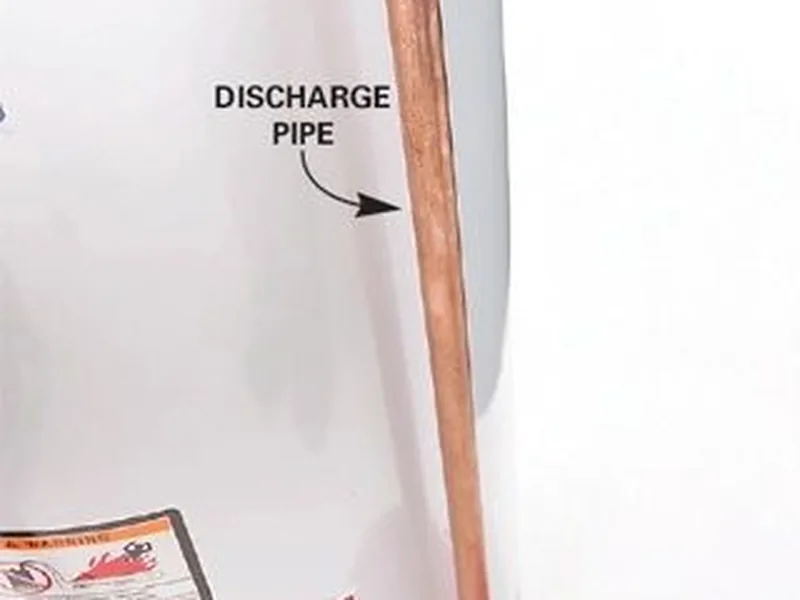
The valve is only half the system; the discharge pipe is the other half, and Taunton homes show us every violation in the book. The rules exist for one reason: when the valve opens, scalding water must exit safely without endangering anyone. The pipe must be full-bore — the same diameter as the valve outlet, never reduced — because a restriction chokes the relief flow the valve was sized to deliver. It must run downward by gravity, with no traps or upward loops where water can sit and scale. It must terminate in a visible, safe location — typically 6 inches above the floor near a drain — never threaded, capped, or valved at the end, and never where discharge can spray onto a person or an electrical panel.
We regularly find discharge pipes that terminate inside walls, run uphill into crawlspaces, or were "temporarily" capped by a previous owner — each one defeats the safety device. As part of every Taunton TPR replacement, we bring the discharge piping into compliance: correct material (rated for hot water), correct routing, correct termination. It is not cosmetic work; a perfectly good new valve discharging through a capped pipe is no better than the failed valve it replaced. When you call (833) 713-2101, mention where your discharge pipe ends — if you cannot see it end, that alone warrants a look.