How Professional Leak Detection Works
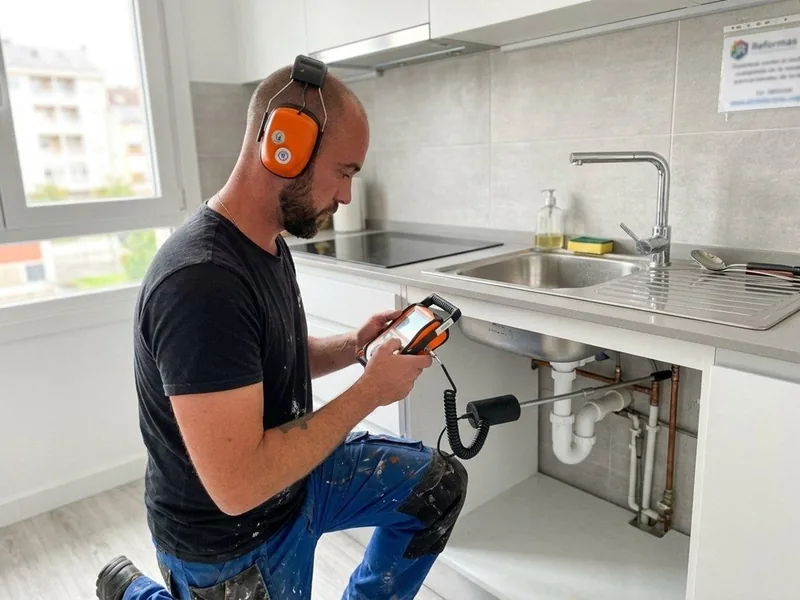
Professional detection is a process of elimination, and it starts before we touch a meter. We interview the symptom: when did you first notice it, does it change with weather or hot water use, has anything changed in the house. Then comes the visual inspection with strong lighting, top to base, including the pipes overhead and the floor around the tank. Next we deploy instruments: pin and pinless moisture meters quantify dampness in concrete, drywall, and wood, establishing what is wet and how wet. Thermal imaging shows temperature differences, revealing the cold track of active water against warm surroundings. If the source is still ambiguous, we isolate: shutting valves to test the hot side versus the cold side, or capping the relief discharge to see if dripping stops. Dye tracing is the last resort for truly hidden paths. Each step narrows the field until only the true source remains. In Berkley, heaters often sit in farmhouse cellars or crawlspaces with dirt floors, where a leak soaks in silently instead of pooling visibly, so catching a leak early makes all the difference.
What That Little Leak Is Really Doing
The math of a slow leak surprises most homeowners. A drip every few seconds adds up to gallons per week, and a thin but steady weep can reach dozens of gallons over a month, all of it going exactly where you do not want it. Unlike a burst pipe, which announces itself immediately, a slow leak buys time for secondary damage: mold colonies establish in 24 to 48 hours on damp drywall, wood framing absorbs moisture and invites rot, and concrete wicks water outward to areas far from the heater. Documentation adds another wrinkle: sudden failures are straightforward to explain, while long-term seepage that a homeowner should have addressed raises harder questions. Documenting when you discovered the leak and acting promptly protects both your home and your position. Damage that never happens needs no repair, which is why finding the leak early matters most. For Berkley homeowners the takeaway is practical: heaters often sit in farmhouse cellars or crawlspaces with dirt floors, where a leak soaks in silently instead of pooling visibly, and a quick professional check settles the question.
Signs Your Water Heater Is Leaking Before You See Water
Most leaks announce themselves quietly. The first sign is often a musty or damp smell in the utility area that was not there last month. Next comes visual evidence: rust streaks running down the tank jacket, a white or green crust on copper fittings, or a darkened ring on the concrete around the tank base. Your water bill may creep upward without any change in habits, and on gas units the pilot may start going out as moisture reaches the burner assembly. Listen, too: new popping or rumbling during heating often means sediment has built up, insulating the tank bottom and stressing the steel. None of these signs means panic, but every one of them means look closer. A flashlight inspection of the tank base, the drain valve, and the pipes overhead takes two minutes and catches most leaks while they are still small enough to manage on your schedule. That matters in Berkley, because heaters often sit in farmhouse cellars or crawlspaces with dirt floors, where a leak soaks in silently instead of pooling visibly.
Water Heater Leak Detection in Berkley: The Local Picture
Berkley homes demand a different detection approach because of well water and farmhouse construction. Mineral-heavy well water attacks anode rods and tank linings from the inside, so tanks here can fail internally while looking fine outside, and the first sign is often a faint metallic smell in hot water or a pilot that keeps going out on gas units. Many heaters sit in farmhouse cellars with dirt or uneven stone floors, where a leak soaks straight down instead of pooling, leaving almost no visible evidence. We bring moisture probes that read into soil and masonry, not just surface meters, and we check the well pressure tank and softener loop too, because well systems add fittings and failure points municipal homes never see. Newer subdivisions on large lots have the opposite problem: heaters in clean utility rooms where a slow fitting leak mists onto drywall. Either way, detection in Berkley means accounting for water chemistry, not just plumbing.
The Usual Suspects: Common Water Heater Leak Points
When we trace a leak, we check the same suspects in order, because experience says the source is almost always one of them. First, the temperature-pressure relief valve and its discharge pipe: these weep when system pressure runs high or the valve ages out, and the discharge often terminates where nobody looks. Second, the drain valve at the tank base, which corrodes, gets bumped, or never fully seats after a flush. Third, the inlet and outlet fittings on top, where dielectric unions join dissimilar metals and galvanic corrosion quietly eats the joint. Fourth, the tank seams themselves, top and bottom, where internal corrosion finally breaks through the steel. Fifth, the anode rod port, which can weep when the rod is consumed. Knowing this order matters because homeowners almost always suspect the tank first, when the real culprit is frequently a fitting that is simple to fix. Because in Berkley, heaters often sit in farmhouse cellars or crawlspaces with dirt floors, where a leak soaks in silently instead of pooling visibly, early detection is worth far more than late repair.
What Happens When You Call
Calling (833) 713-2101 starts a simple process. First, we listen: you describe what you have noticed, and we ask the questions that narrow the possibilities before we arrive. Then we inspect, using visual examination plus moisture meters and thermal imaging to find the true source of the water. Then we explain: what is leaking, why it is happening, how urgent it is, and what each option involves. Homeowners in Berkley, MA 02779 tell us they appreciate the plain talk, especially when the news is that the problem is smaller than feared. Many suspected tank failures turn out to be fittings or valves, and saying so honestly is part of the job. One call gets you an accurate diagnosis and a clear path forward.