What That Little Leak Is Really Doing
There is also the hidden toll of waiting: the emergency premium. A leak found early becomes a scheduled repair or a planned replacement, done on your timeline with time to choose equipment and get the details right. The same leak found late becomes an emergency call, water extraction, potential mold remediation, and a replacement chosen in a hurry. We have watched this play out hundreds of times, and the difference in total outlay is dramatic, often several times over. Beyond money, there is the disruption: a planned replacement takes a few hours, while a flood recovery takes weeks of drying equipment, contractor visits, and displaced living space. When you notice the first sign, a damp smell, a rust streak, a suspicious stain, that is the moment when you have the most options and the lowest outlay. Acting then is the wisest move in home maintenance. That matters in Franklin, because with so many finished basements, heaters frequently back up to living space, making early leak warning especially valuable.
Signs Your Water Heater Is Leaking Before You See Water
Leaks rarely start with a puddle. They start with clues. Discolored hot water, even slightly rusty, tells you the anode rod is exhausted and the tank steel is now corroding. Warm spots on the floor near the heater, or a patch of concrete that never quite dries, point to a slow base leak wicking outward. Check the temperature-pressure relief valve discharge pipe: any dripping there means the valve is weeping or the system pressure is running high. Look up, as well: water stains on the ceiling below an upstairs heater, or on the wall behind the tank, trace back to fitting leaks that spray a fine mist. In humid weather, be careful not to confuse pipe condensation with a leak; condensation follows the weather, while a real leak persists in dry conditions. When in doubt, dry everything with a towel and check again in a few hours. Fresh wetness is your answer. Because in Franklin, with so many finished basements, heaters frequently back up to living space, making early leak warning especially valuable, early detection is worth far more than late repair.
Water Heater Leak Detection in Franklin: The Local Picture
Franklin's sheer variety of housing keeps our detection process flexible. Colonials, capes, and split-levels from every decade each hide heaters differently: split-levels often put them in low crawlspaces, capes in knee-wall attics or basements, colonials in full cellars. We adapt the toolkit to the space, using borescopes for crawlspaces and thermal cameras for finished areas. Charles River headwaters neighborhoods with sump pumps get a combined check, since we regularly find that what looks like a heater leak is actually sump discharge backing up near the tank, or vice versa. Nor'easter season adds urgency, because a heater leak discovered during a storm gets confused with storm water, and accurate diagnosis prevents the wrong repair. In Franklin's denser newer neighborhoods, heaters in garage utility closets face road-salt humidity that corrodes fittings, so we inspect every connection with a dry cloth test, not just a glance.
The Usual Suspects: Common Water Heater Leak Points
When we trace a leak, we check the same suspects in order, because experience says the source is almost always one of them. First, the temperature-pressure relief valve and its discharge pipe: these weep when system pressure runs high or the valve ages out, and the discharge often terminates where nobody looks. Second, the drain valve at the tank base, which corrodes, gets bumped, or never fully seats after a flush. Third, the inlet and outlet fittings on top, where dielectric unions join dissimilar metals and galvanic corrosion quietly eats the joint. Fourth, the tank seams themselves, top and bottom, where internal corrosion finally breaks through the steel. Fifth, the anode rod port, which can weep when the rod is consumed. Knowing this order matters because homeowners almost always suspect the tank first, when the real culprit is frequently a fitting that is simple to fix. In Franklin, with so many finished basements, heaters frequently back up to living space, making early leak warning especially valuable, so catching a leak early makes all the difference.
Ready When You Are: What Happens Next
Calling (833) 713-2101 starts a simple process. First, we listen: you describe what you have noticed, and we ask the questions that narrow the possibilities before we arrive. Then we inspect, using visual examination plus moisture meters and thermal imaging to find the true source of the water. Then we explain: what is leaking, why it is happening, how urgent it is, and what each option involves. Homeowners in Franklin, MA 02038 tell us they appreciate the plain talk, especially when the news is that the problem is smaller than feared. Many suspected tank failures turn out to be fittings or valves, and saying so honestly is part of the job. One call gets you an accurate diagnosis and a clear path forward.
How Professional Leak Detection Works
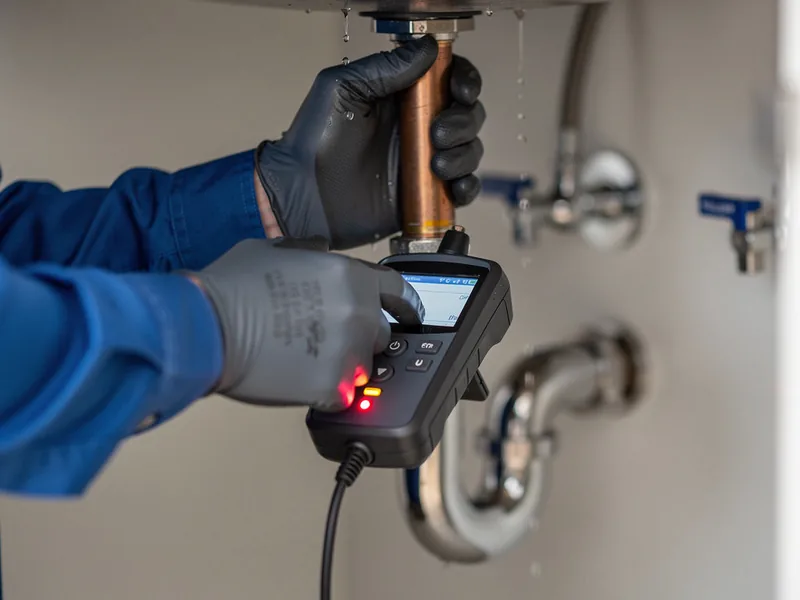
The toolkit matters, but the method matters more. We begin by drying every suspect surface, because you cannot trace a leak through old wetness. Then we watch: fresh moisture appearing at a specific joint or seam is definitive in a way that a generally damp area never is. Moisture meters give us numbers, and numbers let us compare: the tank base versus the foundation wall three feet away tells us whether we are seeing a plumbing leak or background dampness. Thermal cameras excel at finding what eyes miss, a cold drip line inside a wall cavity, or the cool signature of water under a jacket. For intermittent leaks, we may ask about timing: a leak that appears only after showers points to pressure or temperature triggers. The whole process usually takes under an hour, and it ends with a clear statement of what is leaking, how urgently it needs attention, and what the fix options are. For Franklin homeowners the takeaway is practical: with so many finished basements, heaters frequently back up to living space, making early leak warning especially valuable, and a quick professional check settles the question.