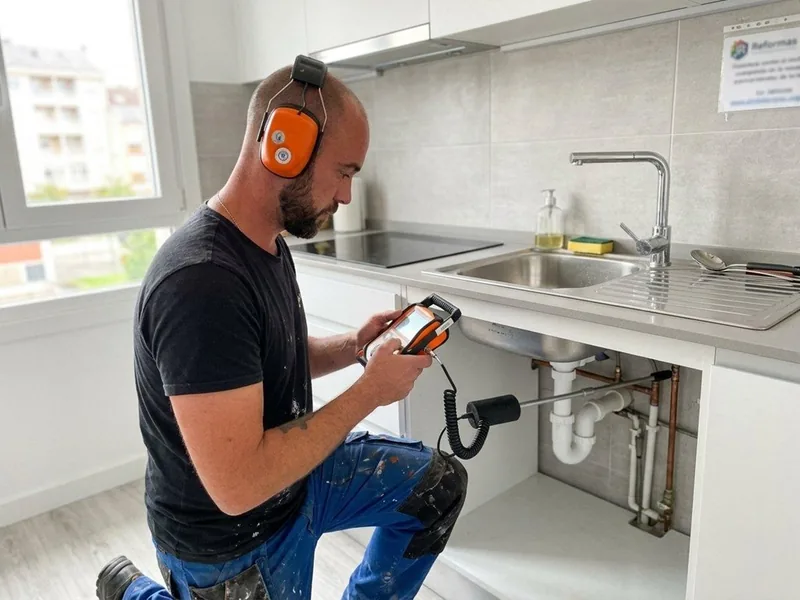
How Professional Leak Detection Works
Professional detection is a process of elimination, and it starts before we touch a meter. We interview the symptom: when did you first notice it, does it change with weather or hot water use, has anything changed in the house. Then comes the visual inspection with strong lighting, top to base, including the pipes overhead and the floor around the tank. Next we deploy instruments: pin and pinless moisture meters quantify dampness in concrete, drywall, and wood, establishing what is wet and how wet. Thermal imaging shows temperature differences, revealing the cold track of active water against warm surroundings. If the source is still ambiguous, we isolate: shutting valves to test the hot side versus the cold side, or capping the relief discharge to see if dripping stops. Dye tracing is the last resort for truly hidden paths. Each step narrows the field until only the true source remains. In Millville, heaters in mill-era homes are often shoehorned into tiny cellar nooks with difficult shutoff access, so catching a leak early makes all the difference.
What That Little Leak Is Really Doing
Small leaks attack in ways you do not expect. Water traveling along a pipe can emerge feet from the heater, staining a ceiling in the room below or a wall in the next room, and homeowners often repair the stain without finding the source, guaranteeing a repeat. On gas heaters, persistent moisture corrodes the burner and pilot assembly, leading to outages that get misdiagnosed as gas supply problems. On electric units, water reaching wiring or thermostats creates both a failure risk and a safety concern that demands immediate attention. Even the floor suffers structurally: a concrete slab wicks leak water outward under finished flooring, and by the time the laminate buckles, the affected area is far larger than the puddle ever was. Every week a known leak continues is a week of compounding damage, which is why detection followed by prompt action is the whole game. For Millville homeowners the takeaway is practical: heaters in mill-era homes are often shoehorned into tiny cellar nooks with difficult shutoff access, and a quick professional check settles the question.
Water Heater Leak Detection in Millville: The Local Picture
Millville's mill-village homes are among the trickiest detection environments in our service area. Heaters get shoehorned into tiny cellar nooks with difficult shutoff access, surrounded by piping from multiple eras, and simply seeing the whole tank can require an inspection mirror and a headlamp. We start by mapping every visible pipe and valve before touching anything, because in these layered systems the leak is frequently not the heater at all but a corroded fitting three feet away dripping onto the tank jacket. Blackstone River valley humidity keeps stone and block basements perpetually damp, so we establish a moisture baseline on dry masonry before evaluating wet spots near the heater. The temperature-pressure relief discharge line gets special attention, since older installs often terminate it where nobody can see the end. For Millville's scattered newer homes, detection follows the standard protocol, but we still verify water chemistry, since valley well water can be surprisingly aggressive on tanks.
Signs Your Water Heater Is Leaking Before You See Water
Leaks rarely start with a puddle. They start with clues. Discolored hot water, even slightly rusty, tells you the anode rod is exhausted and the tank steel is now corroding. Warm spots on the floor near the heater, or a patch of concrete that never quite dries, point to a slow base leak wicking outward. Check the temperature-pressure relief valve discharge pipe: any dripping there means the valve is weeping or the system pressure is running high. Look up, as well: water stains on the ceiling below an upstairs heater, or on the wall behind the tank, trace back to fitting leaks that spray a fine mist. In humid weather, be careful not to confuse pipe condensation with a leak; condensation follows the weather, while a real leak persists in dry conditions. When in doubt, dry everything with a towel and check again in a few hours. Fresh wetness is your answer. That matters in Millville, because heaters in mill-era homes are often shoehorned into tiny cellar nooks with difficult shutoff access.
The Usual Suspects: Common Water Heater Leak Points
When we trace a leak, we check the same suspects in order, because experience says the source is almost always one of them. First, the temperature-pressure relief valve and its discharge pipe: these weep when system pressure runs high or the valve ages out, and the discharge often terminates where nobody looks. Second, the drain valve at the tank base, which corrodes, gets bumped, or never fully seats after a flush. Third, the inlet and outlet fittings on top, where dielectric unions join dissimilar metals and galvanic corrosion quietly eats the joint. Fourth, the tank seams themselves, top and bottom, where internal corrosion finally breaks through the steel. Fifth, the anode rod port, which can weep when the rod is consumed. Knowing this order matters because homeowners almost always suspect the tank first, when the real culprit is frequently a fitting that is simple to fix. Because in Millville, heaters in mill-era homes are often shoehorned into tiny cellar nooks with difficult shutoff access, early detection is worth far more than late repair.
What Happens When You Call
Reaching us at (833) 713-2101 is the fastest way to turn worry into a plan. We will set up a detection visit, arrive prepared, and get to the bottom of the moisture, usually within the hour. You will see what we see: meter readings, thermal images, and the actual leak point, followed by honest guidance on next steps. For Millville, MA 01529 homeowners, that guidance might be a simple repair, a watch-and-wait with a monitoring plan, or a scheduled replacement with time to choose the right equipment. Whatever the outcome, you will know exactly where you stand. Water heater problems reward early action and punish delay, so make the call while the problem is still small.