Signs Your Water Heater Is Leaking Before You See Water
Most leaks announce themselves quietly. The first sign is often a musty or damp smell in the utility area that was not there last month. Next comes visual evidence: rust streaks running down the tank jacket, a white or green crust on copper fittings, or a darkened ring on the concrete around the tank base. Your water bill may creep upward without any change in habits, and on gas units the pilot may start going out as moisture reaches the burner assembly. Listen, too: new popping or rumbling during heating often means sediment has built up, insulating the tank bottom and stressing the steel. None of these signs means panic, but every one of them means look closer. A flashlight inspection of the tank base, the drain valve, and the pipes overhead takes two minutes and catches most leaks while they are still small enough to manage on your schedule. In Norton, heaters typically sit in basements, with a growing share in finished-basement utility rooms as families renovate, so catching a leak early makes all the difference.
Water Heater Leak Detection in Norton: The Local Picture
Norton detection calls reflect a college town's housing cycle. Wheaton College area rentals and student housing see heaters that run hard with high turnover, and leaks get discovered late, often during a vacancy walkthrough, by which time drywall and flooring have absorbed weeks of slow seepage. Our detection there emphasizes speed and documentation: thermal imaging to map the full extent, moisture readings for the record, and source tracing so the repair targets the actual failure. Family neighborhoods around the Norton Reservoir deal with variable water tables, and we compare moisture near the heater against foundation-wall readings to separate groundwater from plumbing leaks. As more Norton families finish their basements, heaters increasingly back onto living space, and we have adapted our protocol with non-invasive scanning first, opening walls only when readings justify it. Newer developments get the standard full check, including dielectric unions and expansion tank condition, since those are the quiet failure points in modern installs.
The Usual Suspects: Common Water Heater Leak Points
When we trace a leak, we check the same suspects in order, because experience says the source is almost always one of them. First, the temperature-pressure relief valve and its discharge pipe: these weep when system pressure runs high or the valve ages out, and the discharge often terminates where nobody looks. Second, the drain valve at the tank base, which corrodes, gets bumped, or never fully seats after a flush. Third, the inlet and outlet fittings on top, where dielectric unions join dissimilar metals and galvanic corrosion quietly eats the joint. Fourth, the tank seams themselves, top and bottom, where internal corrosion finally breaks through the steel. Fifth, the anode rod port, which can weep when the rod is consumed. Knowing this order matters because homeowners almost always suspect the tank first, when the real culprit is frequently a fitting that is simple to fix. For Norton homeowners the takeaway is practical: heaters typically sit in basements, with a growing share in finished-basement utility rooms as families renovate, and a quick professional check settles the question.
How Professional Leak Detection Works
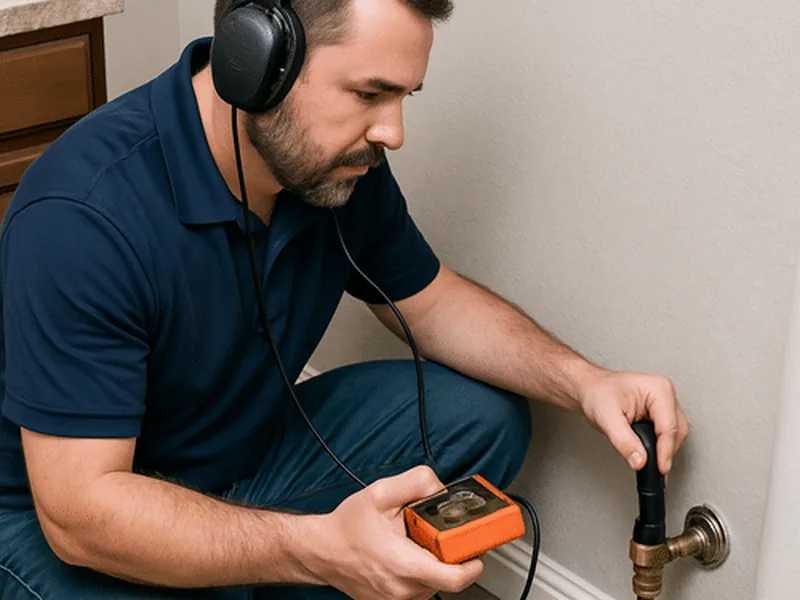
The toolkit matters, but the method matters more. We begin by drying every suspect surface, because you cannot trace a leak through old wetness. Then we watch: fresh moisture appearing at a specific joint or seam is definitive in a way that a generally damp area never is. Moisture meters give us numbers, and numbers let us compare: the tank base versus the foundation wall three feet away tells us whether we are seeing a plumbing leak or background dampness. Thermal cameras excel at finding what eyes miss, a cold drip line inside a wall cavity, or the cool signature of water under a jacket. For intermittent leaks, we may ask about timing: a leak that appears only after showers points to pressure or temperature triggers. The whole process usually takes under an hour, and it ends with a clear statement of what is leaking, how urgently it needs attention, and what the fix options are. That matters in Norton, because heaters typically sit in basements, with a growing share in finished-basement utility rooms as families renovate.
What That Little Leak Is Really Doing
Small leaks attack in ways you do not expect. Water traveling along a pipe can emerge feet from the heater, staining a ceiling in the room below or a wall in the next room, and homeowners often repair the stain without finding the source, guaranteeing a repeat. On gas heaters, persistent moisture corrodes the burner and pilot assembly, leading to outages that get misdiagnosed as gas supply problems. On electric units, water reaching wiring or thermostats creates both a failure risk and a safety concern that demands immediate attention. Even the floor suffers structurally: a concrete slab wicks leak water outward under finished flooring, and by the time the laminate buckles, the affected area is far larger than the puddle ever was. Every week a known leak continues is a week of compounding damage, which is why detection followed by prompt action is the whole game. Because in Norton, heaters typically sit in basements, with a growing share in finished-basement utility rooms as families renovate, early detection is worth far more than late repair.
What Happens When You Call
Here is our promise when you dial (833) 713-2101: a real diagnosis, not a sales pitch. Our technician will find where the water is coming from, document it, and walk you through what it means. If it is a minor fitting or valve issue, we will tell you exactly that and fix it if you like. If the tank is failing, we will explain why, show you the evidence, and discuss timing, because a planned replacement beats an emergency every time. We serve Norton, MA 02766 with the same care we would want in our own homes: shoe covers, clear communication, and no mess left behind. The sooner you call, the more options you have, so do not wait for the puddle to make the decision for you.