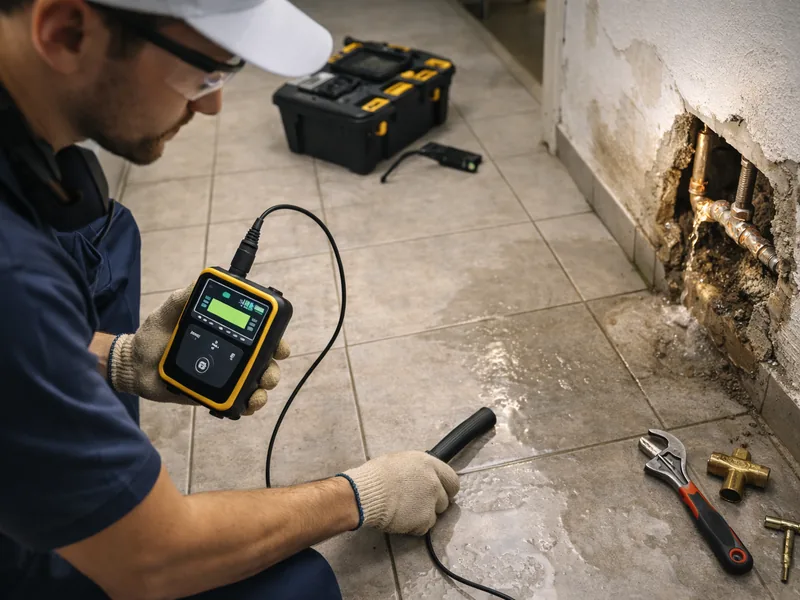
How Professional Leak Detection Works
Every detection visit ends with documentation and straight talk. We photograph what we find, record moisture readings, and show you the evidence, not just the conclusion. Then we lay out options in plain terms: what can be repaired, what should be monitored, and what needs replacement, with the reasoning for each. If the tank itself is failing, we explain why repair is not viable and what a planned replacement involves, so you can decide on timing rather than being forced into an emergency. If the problem is a fitting or valve, we explain the repair and what to watch afterward. We also flag contributing conditions, high system pressure, a failed expansion tank, aggressive water chemistry, because fixing the leak without addressing the cause invites a repeat. You leave the visit knowing exactly where you stand. In Raynham, heaters in newer developments sit in clean utility rooms, while older capes keep them in low crawlspaces, so catching a leak early makes all the difference.
What That Little Leak Is Really Doing
The math of a slow leak surprises most homeowners. A drip every few seconds adds up to gallons per week, and a thin but steady weep can reach dozens of gallons over a month, all of it going exactly where you do not want it. Unlike a burst pipe, which announces itself immediately, a slow leak buys time for secondary damage: mold colonies establish in 24 to 48 hours on damp drywall, wood framing absorbs moisture and invites rot, and concrete wicks water outward to areas far from the heater. Documentation adds another wrinkle: sudden failures are straightforward to explain, while long-term seepage that a homeowner should have addressed raises harder questions. Documenting when you discovered the leak and acting promptly protects both your home and your position. Damage that never happens needs no repair, which is why finding the leak early matters most. For Raynham homeowners the takeaway is practical: heaters in newer developments sit in clean utility rooms, while older capes keep them in low crawlspaces, and a quick professional check settles the question.
Signs Your Water Heater Is Leaking Before You See Water
Leaks rarely start with a puddle. They start with clues. Discolored hot water, even slightly rusty, tells you the anode rod is exhausted and the tank steel is now corroding. Warm spots on the floor near the heater, or a patch of concrete that never quite dries, point to a slow base leak wicking outward. Check the temperature-pressure relief valve discharge pipe: any dripping there means the valve is weeping or the system pressure is running high. Look up, as well: water stains on the ceiling below an upstairs heater, or on the wall behind the tank, trace back to fitting leaks that spray a fine mist. In humid weather, be careful not to confuse pipe condensation with a leak; condensation follows the weather, while a real leak persists in dry conditions. When in doubt, dry everything with a towel and check again in a few hours. Fresh wetness is your answer. That matters in Raynham, because heaters in newer developments sit in clean utility rooms, while older capes keep them in low crawlspaces.
Water Heater Leak Detection in Raynham: The Local Picture
Raynham detection has to account for the Taunton River lowlands. Seasonal high water tables mean many basements run damp in spring, and our first job on any call is establishing what is normal dampness for that house before evaluating the heater area. We take comparative readings at the foundation walls, the sump pit, and the heater base, and only a localized spike at the heater indicates a plumbing leak rather than groundwater. Older capes near the village often keep heaters in low crawlspaces, where we deploy borescopes and remote moisture sensors rather than squeezing in blind. In the large newer developments, heaters sit in clean utility rooms, but the same river humidity accelerates exterior rust, so we distinguish cosmetic surface rust from active seepage with dry testing. Route 44 corridor homes with finished basements get the non-invasive protocol first: thermal scan of surrounding walls, then targeted access only where readings justify it.
The Usual Suspects: Common Water Heater Leak Points
When we trace a leak, we check the same suspects in order, because experience says the source is almost always one of them. First, the temperature-pressure relief valve and its discharge pipe: these weep when system pressure runs high or the valve ages out, and the discharge often terminates where nobody looks. Second, the drain valve at the tank base, which corrodes, gets bumped, or never fully seats after a flush. Third, the inlet and outlet fittings on top, where dielectric unions join dissimilar metals and galvanic corrosion quietly eats the joint. Fourth, the tank seams themselves, top and bottom, where internal corrosion finally breaks through the steel. Fifth, the anode rod port, which can weep when the rod is consumed. Knowing this order matters because homeowners almost always suspect the tank first, when the real culprit is frequently a fitting that is simple to fix. Because in Raynham, heaters in newer developments sit in clean utility rooms, while older capes keep them in low crawlspaces, early detection is worth far more than late repair.
What Happens When You Call
When you call (833) 713-2101, here is what happens. We schedule a detection visit at a time that works for you, and our technician arrives with the full diagnostic toolkit: moisture meters, thermal imaging, and pressure testing gear. The visit usually takes under an hour. We trace the moisture to its exact source, show you the evidence, and explain your options plainly: repair, monitor, or plan a replacement. There is no pressure and no obligation beyond the diagnosis. If the fix is simple, we can often handle it on the spot. If the tank is failing, we will give you a straight assessment of timing so you can plan rather than panic. Serving Raynham, MA 02767 and surrounding towns, we answer when you call.