What That Little Leak Is Really Doing
The math of a slow leak surprises most homeowners. A drip every few seconds adds up to gallons per week, and a thin but steady weep can reach dozens of gallons over a month, all of it going exactly where you do not want it. Unlike a burst pipe, which announces itself immediately, a slow leak buys time for secondary damage: mold colonies establish in 24 to 48 hours on damp drywall, wood framing absorbs moisture and invites rot, and concrete wicks water outward to areas far from the heater. Documentation adds another wrinkle: sudden failures are straightforward to explain, while long-term seepage that a homeowner should have addressed raises harder questions. Documenting when you discovered the leak and acting promptly protects both your home and your position. Damage that never happens needs no repair, which is why finding the leak early matters most. That matters in Rehoboth, because heaters often serve large homes far from town water, sitting in basements or crawlspaces checked rarely.
Water Heater Leak Detection in Rehoboth: The Local Picture
Rehoboth may be our most demanding detection territory, and the reasons are all local. Wells and septic are the rule, and iron-heavy well water with sediment chews through anode rods and tank linings, so tanks fail from the inside while the jacket looks intact. We always sample the drain valve's first draw and inspect the anode port, because water chemistry tells us as much as any meter. Farmhouses and antique colonials hide heaters in basements and crawlspaces that are dark, cramped, and visited rarely, which means leaks run long before discovery; we bring serious lighting and probes that read into soil and masonry where leaks disappear downward. New construction on large wooded lots has the opposite profile: clean mechanical rooms, but heaters serving big homes with high demand, where thermal expansion stress cracks fittings. Across Rehoboth's spread-out geography, we also make sure homeowners know their main water shutoff location, since a leak discovered at 10 p.m. on a rural road needs an immediate homeowner response.
Signs Your Water Heater Is Leaking Before You See Water
Your senses pick up leaks before your eyes do. That faint hot, metallic smell near the heater often accompanies the first internal corrosion breakthrough. A floor drain that seems damper than usual, or a sump pit cycling more often without rain, can mean leak water is finding its way there. If the heater shares space with a furnace or boiler, listen for new hissing or sizzling sounds that suggest water meeting hot surfaces. Visual checks should include the top of the tank, where inlet and outlet fittings live: green corrosion on copper, rust on steel nipples, or mineral crust at threaded joints all signal slow weeps. Also inspect the draft hood area on gas units for rust streaks, which indicate flue gas condensation or water intrusion from above. Catching any of these early turns a potential flood into a scheduled repair. Because in Rehoboth, heaters often serve large homes far from town water, sitting in basements or crawlspaces checked rarely, early detection is worth far more than late repair.
The Usual Suspects: Common Water Heater Leak Points
Condensation deserves its own mention because it causes so many false alarms. Cold water entering the tank chills the steel, and in humid conditions moisture condenses on the jacket and fittings, dripping down exactly like a leak. Flue gas condensation on gas units adds another mimic, especially with short or cool venting. We distinguish condensation from leakage with simple, reliable tests: wiping the tank dry and watching whether moisture returns in step with the heater's firing cycle or with the weather, and checking whether the water is on cold supply pipes, which sweat, versus the tank base, which should stay dry. Getting this right matters because the fixes are completely different: condensation calls for ventilation or insulation, while a real leak calls for repair or replacement. Accurate detection means never paying for the wrong fix. In Rehoboth, heaters often serve large homes far from town water, sitting in basements or crawlspaces checked rarely, so catching a leak early makes all the difference.
Ready When You Are: What Happens Next
Calling (833) 713-2101 starts a simple process. First, we listen: you describe what you have noticed, and we ask the questions that narrow the possibilities before we arrive. Then we inspect, using visual examination plus moisture meters and thermal imaging to find the true source of the water. Then we explain: what is leaking, why it is happening, how urgent it is, and what each option involves. Homeowners in Rehoboth, MA 02769 tell us they appreciate the plain talk, especially when the news is that the problem is smaller than feared. Many suspected tank failures turn out to be fittings or valves, and saying so honestly is part of the job. One call gets you an accurate diagnosis and a clear path forward.
How Professional Leak Detection Works
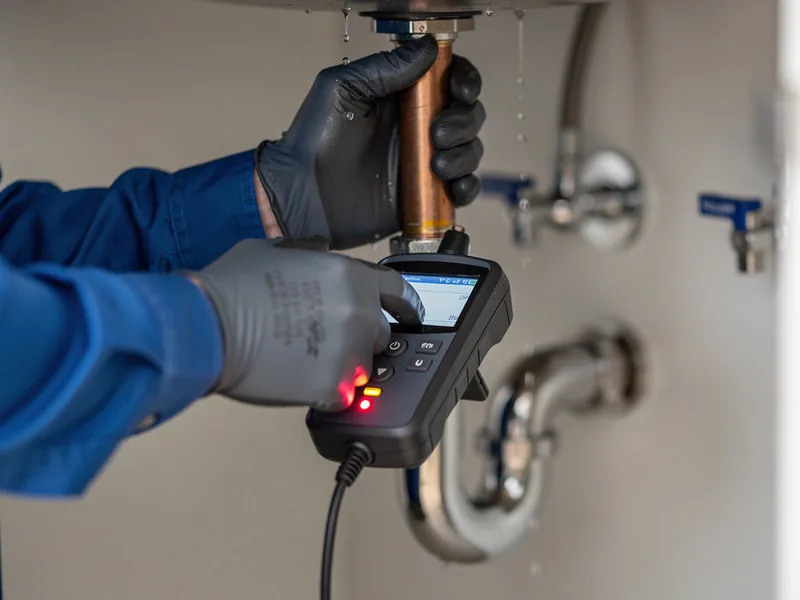
The toolkit matters, but the method matters more. We begin by drying every suspect surface, because you cannot trace a leak through old wetness. Then we watch: fresh moisture appearing at a specific joint or seam is definitive in a way that a generally damp area never is. Moisture meters give us numbers, and numbers let us compare: the tank base versus the foundation wall three feet away tells us whether we are seeing a plumbing leak or background dampness. Thermal cameras excel at finding what eyes miss, a cold drip line inside a wall cavity, or the cool signature of water under a jacket. For intermittent leaks, we may ask about timing: a leak that appears only after showers points to pressure or temperature triggers. The whole process usually takes under an hour, and it ends with a clear statement of what is leaking, how urgently it needs attention, and what the fix options are. For Rehoboth homeowners the takeaway is practical: heaters often serve large homes far from town water, sitting in basements or crawlspaces checked rarely, and a quick professional check settles the question.