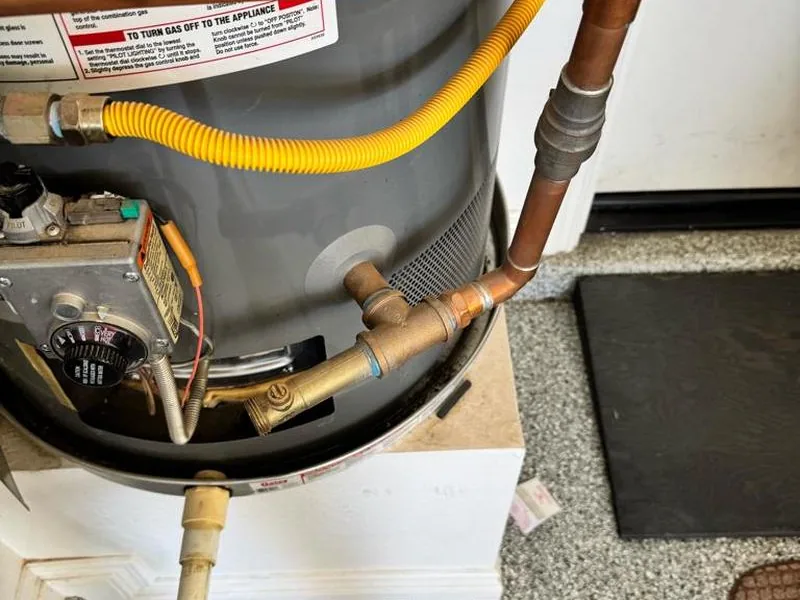
Why the Drain Line Makes or Breaks the Pan
The drain also needs to stay working for years, not just on day one. We use materials that resist the basement environment, secure the piping so it cannot sag over time, and keep the run as short and straight as the space allows, because every bend is a future clog point. The pan's drain fitting itself gets sealed properly to the pan, a detail that sounds obvious but is skipped in hurried installs, leading to the memorable failure of water leaking around the drain instead of through it. We keep the drain line independent of other systems where possible, so a backed-up washing machine or a clogged condensate line cannot push water back into the pan. And we show you the termination point before we leave, because a homeowner who knows where the pan drains can check it in thirty seconds during a routine basement walkthrough. That matters in Bellingham, because heaters commonly live in unfinished basements or garage utility corners, where drips stain concrete long before anyone looks.
Pan Materials and Sizing: Getting the Details Right
Retrofit sizing brings special challenges that new construction never sees. Existing heaters often sit in spaces that were never designed for a pan: tight closets, corners boxed in by piping, clearances eaten by finished walls. We measure the real, as-built space and select pans accordingly, sometimes choosing a pan with a side drain outlet instead of a bottom one to fit the available routing, or shifting the heater a few inches on a new stand to create the needed clearance. What we do not do is install a pan that does not fit and call it done; a pan jammed in crooked, with the drain stressed and the heater off-center, is worse than an honest conversation about reconfiguring the space. Most retrofits are entirely feasible with the right pan choice and a thoughtful drain route, and we will show you the plan before any work begins. In Bellingham, heaters commonly live in unfinished basements or garage utility corners, where drips stain concrete long before anyone looks, so the pan, drain, and sensor earn their keep.
Pan Installation in Bellingham: Local Conditions That Shape the Job
In Bellingham, pan installation works hand in hand with the sump systems so many homes already have. The ideal setup routes the pan drain directly to the sump pit, so any leak gets pumped out automatically, but the routing has to respect pitch and avoid tying into the sump discharge in a way that could back-feed. We see heaters in unfinished basements here where a pan drain can run exposed along the wall, which keeps the install simple and inspectable. Spring runoff in the Charles River headwaters keeps those sumps cycling, so we verify the pit has capacity and the pump is working before depending on it. In newer developments with garage utility corners, the pan drain often terminates through the exterior wall, and we make sure that termination stays clear of mulch and grading. Either way, the pan gets paired with a leak sensor puck, because a drain handles the water while the sensor provides the alert.
Sensors and Shutoffs That Watch When You Cannot
A pan without a sensor is a silent guardian; it handles the water but never tells you it did. That is why every pan we install includes a leak sensor puck placed at the pan's low point, where water will reach it first. Basic sensors sound a local audible alarm, which is enough if someone is home to hear it. Smart sensors go further, sending alerts to your phone, which matters for households empty all day, frequent travelers, and rental properties. The sensor's job is simple and vital: convert a hidden leak into a notification within minutes instead of a discovery weeks later. We test every sensor at installation by wetting it, because an untested sensor is a hope, not a device. Placement matters as much as the device itself, and we position it where the pan's drainage pattern will actually deliver water to it. In Bellingham, heaters commonly live in unfinished basements or garage utility corners, where drips stain concrete long before anyone looks, which is exactly the situation a proper pan is made for.
Ready When You Are: What Happens Next
Reach us at (833) 713-2101 and we will get your pan installation scheduled promptly. The visit itself is efficient: measure, plan the drain route, install the pan level on a proper base, run the drain line with consistent pitch to the right termination, install and test the sensor, and review everything with you. For Bellingham homeowners replacing a heater at the same time, we coordinate the pan with the replacement so the new unit lands in a fully protected setup from day one. Serving Bellingham, MA 02019 and nearby towns, we answer our phone and show up when we say we will. Protect the floors you care about before the leak, not after.
What a Water Heater Pan Actually Does
A water heater pan is a wide, shallow, rigid tray that sits directly under the water heater. Its job is to catch slow leaks, drips from fittings, relief valve discharges, and condensation, and to direct that water into a drain line instead of letting it spread across your floor. Think of the leaks a pan handles: the weeping tank seam, the dripping drain valve, the sweating fitting. These are the leaks that run for weeks unnoticed, and a pan intercepts every one of them at the source. What a pan cannot do is contain a catastrophic tank rupture; if 50 gallons let go at once, the pan overflows. But catastrophic ruptures are rare, while slow leaks are the norm, and for the leaks you are actually likely to get, a pan changes everything. Paired with a leak sensor, it turns a potential disaster into a maintenance notification. For Bellingham homes, where heaters commonly live in unfinished basements or garage utility corners, where drips stain concrete long before anyone looks, a pan with a real drain is the sensible baseline.