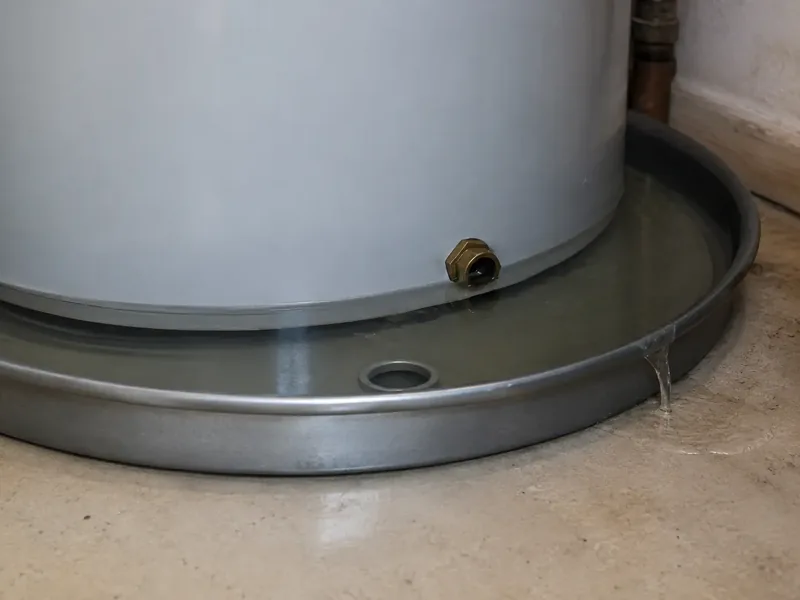
What a Water Heater Pan Actually Does
Building codes in many jurisdictions require pans for heaters in certain locations, particularly where a leak would damage finished space, and the reason is simple experience: pans work. But a code-minimum pan installed poorly is barely better than none. The pans we install are rigid aluminum, deep enough to contain a meaningful volume, and sized with at least two inches of clearance around the heater so drips from top fittings land inside, not beside. The pan sits dead level, because a tilted pan pools water at one end and starves the drain at the other. And critically, the pan has a drain: a full-size line, pitched consistently, terminating at a floor drain, sump pit, or exterior point where the water can go without causing new problems. That complete assembly is what we mean by a pan installation. In Dighton, heaters range from basement units in old colonials to garage installs in newer builds, and river humidity keeps rust moving fast, which is exactly the situation a proper pan is made for.
Why the Drain Line Makes or Breaks the Pan
The drain also needs to stay working for years, not just on day one. We use materials that resist the basement environment, secure the piping so it cannot sag over time, and keep the run as short and straight as the space allows, because every bend is a future clog point. The pan's drain fitting itself gets sealed properly to the pan, a detail that sounds obvious but is skipped in hurried installs, leading to the memorable failure of water leaking around the drain instead of through it. We keep the drain line independent of other systems where possible, so a backed-up washing machine or a clogged condensate line cannot push water back into the pan. And we show you the termination point before we leave, because a homeowner who knows where the pan drains can check it in thirty seconds during a routine basement walkthrough. For Dighton homes, where heaters range from basement units in old colonials to garage installs in newer builds, and river humidity keeps rust moving fast, a pan with a real drain is the sensible baseline.
Pan Installation in Dighton: Local Conditions That Shape the Job
Dighton's riverfront geography dictates pan drain design. In flood-prone pockets near the Taunton River, a pan drain that terminates too low can back-feed during high water, so we route terminations with flood levels in mind, favoring interior floor drains or elevated exterior outlets. The pan itself is only half the system here; pairing it with a leak sensor and an automatic shutoff valve matters more in Dighton than in most towns, because a leak during a storm week might otherwise go unnoticed while the homeowner is focused on the river. Older colonials with stone foundations need a level platform built before the pan goes in, since nothing in those cellars is flat. Outlying well-water homes get aluminum pans for corrosion resistance against mineral-heavy water. We also make sure the pan drain never ties into a line that could carry river water backward, a detail that gets missed in hurried installs.
Pan Materials and Sizing: Getting the Details Right
The heater's placement within the pan deserves the same care as the pan's placement in the room. The unit should sit centered, so clearance is even all around and the drain fitting is at the pan's true low point. On uneven floors, and many basement floors are uneven, we build a level platform first: shimming a pan directly is a short-term fix that shifts over time, while a proper rigid platform stays true. The platform also lifts the pan slightly out of ambient floor dampness, which extends the life of both the pan and the heater base. For heaters on existing stands, we verify the stand is sound and level before the pan goes under it. These foundation details are invisible once the job is done, which is exactly why they get skipped by careless installers, and exactly why we do them. That matters in Dighton, because heaters range from basement units in old colonials to garage installs in newer builds, and river humidity keeps rust moving fast.
Sensors and Shutoffs That Watch When You Cannot
The automatic shutoff valve is the next step up, and for many homes it is the right one. This valve installs on the water supply to the heater and closes automatically when the sensor detects water, stopping the leak at its source rather than just managing the water after the fact. Consider the difference: without a shutoff, a supply-side leak can run for hours, overwhelming even a well-drained pan; with a shutoff, the flow stops within moments of detection. We recommend shutoff valves especially for finished basements, homes empty during workdays, vacation properties, and rentals, anywhere that a leak might run unattended. The valve is a mechanical device with a long service life, and we install full-port valves that do not restrict normal water flow. It is the closest thing to a guarantee that a heater leak stays small. In Dighton, heaters range from basement units in old colonials to garage installs in newer builds, and river humidity keeps rust moving fast, so the pan, drain, and sensor earn their keep.
What Happens When You Call
Here is our standard when you dial (833) 713-2101: the right pan for the space, installed level, drained properly, sensored, and tested. No shortcuts on pitch, no drain to nowhere, no untested sensor. Our technician will show you the drain termination, demonstrate the sensor alarm, and explain the simple annual checks that keep the system reliable. For Dighton, MA 02715 homes with finished basements, we will give you a straight recommendation on the automatic shutoff valve based on how the home is used, not on upsell targets. We treat your home carefully throughout, and we stand behind the workmanship. A pan installation is a small job; we treat it with the care of a big one.