Sensors and Shutoffs That Watch When You Cannot
Sensors need a little ongoing attention to stay reliable, and we set you up for it. Battery-powered pucks need battery checks on a schedule we will suggest; hardwired or smart sensors need their connections verified. We show you where the sensor sits and what its alarm sounds like, so a 2 a.m. alert is recognizable rather than mysterious. For smart sensors, we help with the initial setup and notification testing. The shutoff valve benefits from an occasional manual exercise, which we demonstrate, to keep it operating freely. None of this is burdensome, a few minutes a year, but it is the difference between a protection system and a protection ornament. We also tag the main water shutoff during every install, because the fastest response to any leak is still a homeowner who knows exactly where to turn the water off. That matters in Franklin, because with so many finished basements, heaters frequently back up to living space, making early leak warning especially valuable.
What a Water Heater Pan Actually Does
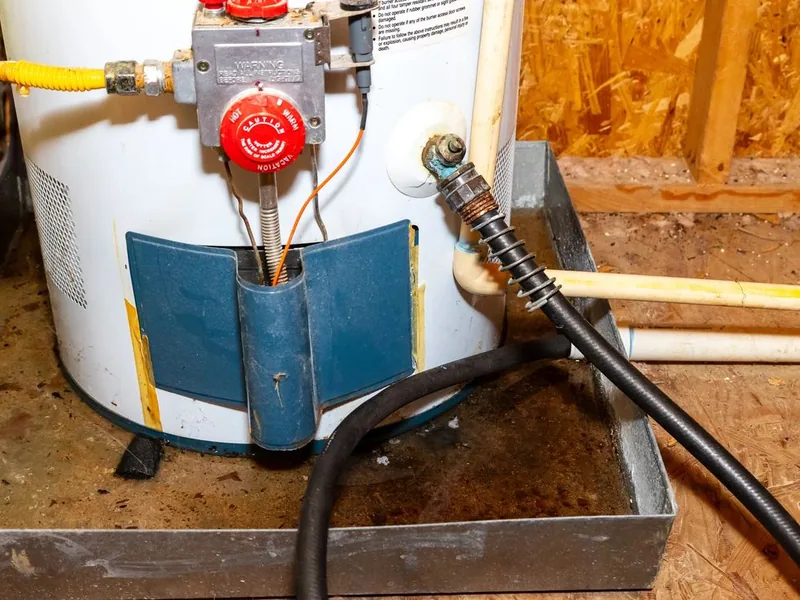
The honest way to think about a drain pan is as part of a system, not a magic shield. The pan catches water. The drain line carries it away. The sensor alerts you. The shutoff valve, if you add one, stops the supply. Each piece has a job, and the pan is the foundation. Without a pan, even a perfect sensor only tells you that water is already on your floor. With a pan, the water never reaches the floor in the first place, and the sensor tells you the pan is doing its job. This matters most where the heater sits above or adjacent to finished space, because there water reaching the floor damages flooring, drywall, and feeds mold inside walls. A pan installation is a small, one-time job that permanently limits what every future heater problem can do to your home. In Franklin, with so many finished basements, heaters frequently back up to living space, making early leak warning especially valuable, so the pan, drain, and sensor earn their keep.
Pan Installation in Franklin: Local Conditions That Shape the Job
Franklin's housing variety means pan installs adapt to the house. Split-levels with heaters in low crawlspaces need low-profile pans and creative drain routing, often a condensate-style pump when gravity drainage is impossible. Capes with heaters in knee-wall attics are a special case: any leak there rains into the rooms below, so the pan gets an oversized drain and a sensor with an audible alarm, not just a silent puck. Colonials with full basements follow the standard pattern: level pan, pitched full-size drain to floor drain or sump, sensor included. Charles River headwaters neighborhoods with sump pumps integrate well, but we verify the pump before relying on it. Nor'easter season is when Franklin pans earn their keep, catching the slow fitting leak that a storm-week distraction would otherwise let run. In garage utility closets, we route pan drains through the exterior wall with proper sealing against drafts and pests.
Why the Drain Line Makes or Breaks the Pan
Here is the open secret of the pan industry: most pans fail not because the pan is wrong but because the drain is. A pan with no drain is a shallow bowl; once it fills, water goes over the edge exactly as if the pan were not there. A pan with a drain that runs uphill, ties into a blocked line, or terminates where water cannot go is barely better. Our installations treat the drain as the main event. We run full-size drain piping, typically three-quarter inch minimum, with consistent pitch along the entire run, no sags, no traps that are not supposed to be there. The termination goes to a floor drain, a sump pit, or an exterior point, chosen for that specific home. We test the drain by pouring water into the pan and watching it leave, because a drain that has never been tested is a guess, not a system. In Franklin, with so many finished basements, heaters frequently back up to living space, making early leak warning especially valuable, which is exactly the situation a proper pan is made for.
Ready When You Are: What Happens Next
Calling (833) 713-2101 starts with a conversation, not a sales pitch. Tell us where your heater sits and what is around it, and we will explain the right pan, drain route, and sensor setup for your Franklin, MA 02038 home. On installation day, we protect your floors along the work path, build a level base where the floor needs it, set the pan, run the drain with true pitch, place and test the sensor, and walk you through everything before we leave. If your heater is hard to access or the space is unusual, we will tell you the plan honestly rather than improvising on site. Homeowners appreciate knowing exactly what is happening and why, and that is how we work.
Pan Materials and Sizing: Getting the Details Right
Sizing a pan is not guesswork. The pan must extend at least two inches beyond the heater's footprint on all sides, because drips from top fittings fall outside the tank's diameter, and a pan that just matches the base misses them. At the same time, the pan must fit the actual space: the utility closet, the cellar nook, the clearances required around the heater for service and combustion air. We measure the heater, the space, and the path the drain must take, then choose the pan that satisfies all three. Height clearance matters as well; the pan raises the heater slightly, and in tight spaces that can affect venting connections on gas units or headroom for service. Getting this right on paper before ordering parts is what separates a professional install from a improvisation with a stock pan. For Franklin homes, where with so many finished basements, heaters frequently back up to living space, making early leak warning especially valuable, a pan with a real drain is the sensible baseline.