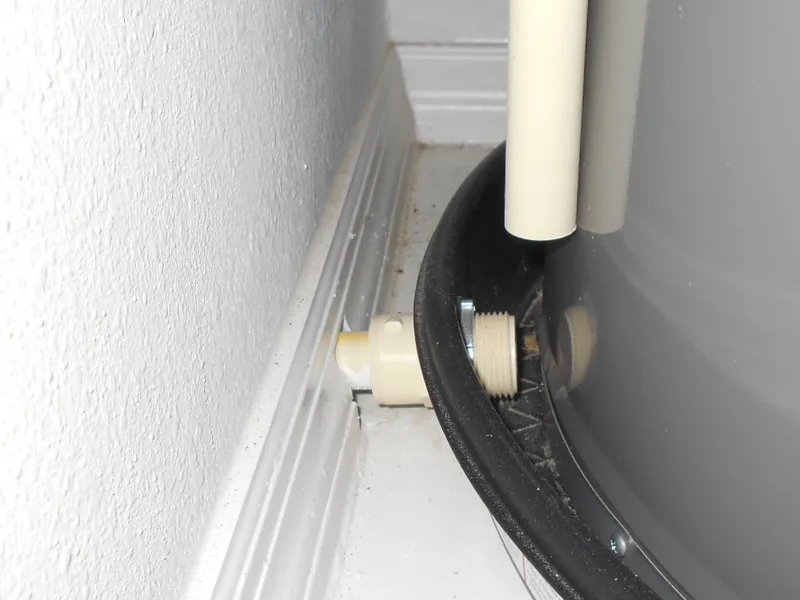
What a Water Heater Pan Actually Does
Building codes in many jurisdictions require pans for heaters in certain locations, particularly where a leak would damage finished space, and the reason is simple experience: pans work. But a code-minimum pan installed poorly is barely better than none. The pans we install are rigid aluminum, deep enough to contain a meaningful volume, and sized with at least two inches of clearance around the heater so drips from top fittings land inside, not beside. The pan sits dead level, because a tilted pan pools water at one end and starves the drain at the other. And critically, the pan has a drain: a full-size line, pitched consistently, terminating at a floor drain, sump pit, or exterior point where the water can go without causing new problems. That complete assembly is what we mean by a pan installation. In Mansfield, heaters in newer subdivisions often sit in clean utility rooms, while center-of-town homes hide them in old stone cellars, which is exactly the situation a proper pan is made for.
Why the Drain Line Makes or Breaks the Pan
Pitch is the unglamorous detail that determines whether a drain works. Water does not flow uphill, and it barely flows on the flat; a drain line needs consistent downward slope from the pan to the termination, along every inch of the run. In real basements, achieving this means planning the route before cutting pipe, using hangers and supports to hold the slope, and avoiding the temptation to run the line wherever is convenient regardless of grade. We check pitch with a level, not by eye, because eyes lie about small slopes. Where gravity drainage is genuinely impossible, such as a heater in a pit or a below-grade space with no lower termination, we install a condensate pump with a check valve and an alarm, so the system still moves water and tells you if the pump fails. There is always a way to drain a pan; the job is finding the right one for the space. For Mansfield homes, where heaters in newer subdivisions often sit in clean utility rooms, while center-of-town homes hide them in old stone cellars, a pan with a real drain is the sensible baseline.
Pan Materials and Sizing: Getting the Details Right
Sizing a pan is not guesswork. The pan must extend at least two inches beyond the heater's footprint on all sides, because drips from top fittings fall outside the tank's diameter, and a pan that just matches the base misses them. At the same time, the pan must fit the actual space: the utility closet, the cellar nook, the clearances required around the heater for service and combustion air. We measure the heater, the space, and the path the drain must take, then choose the pan that satisfies all three. Height clearance matters as well; the pan raises the heater slightly, and in tight spaces that can affect venting connections on gas units or headroom for service. Getting this right on paper before ordering parts is what separates a professional install from a improvisation with a stock pan. That matters in Mansfield, because heaters in newer subdivisions often sit in clean utility rooms, while center-of-town homes hide them in old stone cellars.
Pan Installation in Mansfield: Local Conditions That Shape the Job
Mansfield pan installs reflect the town's two housing eras. In subdivisions built from the 1980s onward, heaters sit in clean utility rooms where a pan drops in easily: level floor, straightforward drain routing to a floor drain or exterior wall, sensor puck placed at the pan's low point. These installs are quick and we use the time to verify the relief valve discharge and expansion tank too. Town-center historic homes are the real work: old stone cellars with uneven floors need a leveled platform first, and drain routing often means surface-mounting a line to a sump pit or coring through a thick foundation wall. Commuter households that are empty all day benefit most from adding the automatic shutoff valve, since nobody is home to hear a sensor alarm. Older streets that pond water near foundations get drains routed with extra care to avoid any path that groundwater could reverse.
Sensors and Shutoffs That Watch When You Cannot
The automatic shutoff valve is the next step up, and for many homes it is the right one. This valve installs on the water supply to the heater and closes automatically when the sensor detects water, stopping the leak at its source rather than just managing the water after the fact. Consider the difference: without a shutoff, a supply-side leak can run for hours, overwhelming even a well-drained pan; with a shutoff, the flow stops within moments of detection. We recommend shutoff valves especially for finished basements, homes empty during workdays, vacation properties, and rentals, anywhere that a leak might run unattended. The valve is a mechanical device with a long service life, and we install full-port valves that do not restrict normal water flow. It is the closest thing to a guarantee that a heater leak stays small. In Mansfield, heaters in newer subdivisions often sit in clean utility rooms, while center-of-town homes hide them in old stone cellars, so the pan, drain, and sensor earn their keep.
What Happens When You Call
Reach us at (833) 713-2101 and we will get your pan installation scheduled promptly. The visit itself is efficient: measure, plan the drain route, install the pan level on a proper base, run the drain line with consistent pitch to the right termination, install and test the sensor, and review everything with you. For Mansfield homeowners replacing a heater at the same time, we coordinate the pan with the replacement so the new unit lands in a fully protected setup from day one. Serving Mansfield, MA 02048 and nearby towns, we answer our phone and show up when we say we will. Protect the floors you care about before the leak, not after.