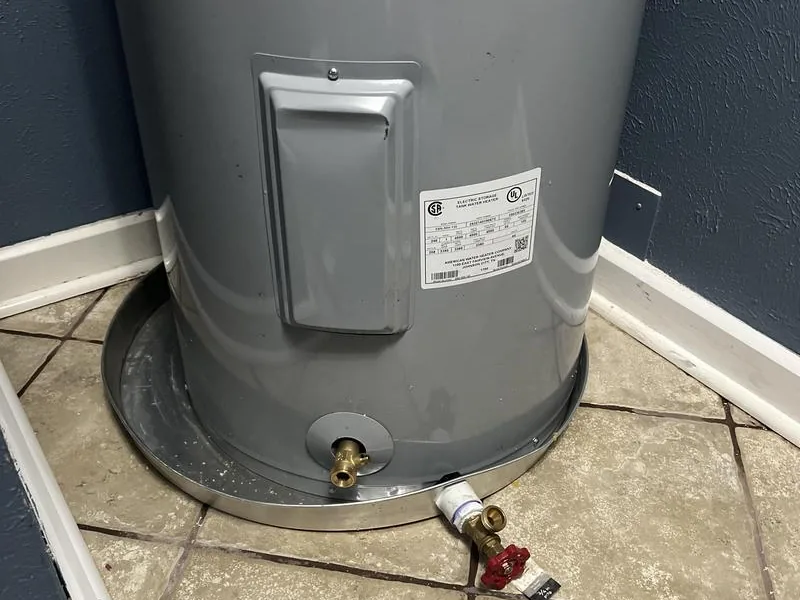
Pan Materials and Sizing: Getting the Details Right
Not all pans are equal, and the differences matter in a basement environment. We install rigid aluminum pans as our standard, because aluminum resists corrosion in damp basements, holds its shape under a full heater, and does not become brittle with age the way some plastics can in cold, damp conditions. Plastic pans have their place and meet code in many situations, but in the humid basements common around here, aluminum's durability wins. Galvanized steel pans exist but we avoid them; the galvanizing eventually fails in constant dampness and then the pan itself rusts. Depth matters too: a deeper pan holds more water before the drain must keep up, buying margin during a fast leak. We select the pan for the heater's footprint and the space's conditions, prioritizing fit and durability. In Millville, heaters in mill-era homes are often shoehorned into tiny cellar nooks with difficult shutoff access, which is exactly the situation a proper pan is made for.
Sensors and Shutoffs That Watch When You Cannot
Choosing between sensor-only and sensor-plus-shutoff comes down to how your home is used. If someone is home most days and the heater sits in an unfinished basement over a floor drain, a sensor puck with an audible alarm is proportionate protection: you will hear it, walk down, and handle it. If the heater backs onto finished space, if the household is gone ten hours a day, if the property is a rental or a second home, the automatic shutoff earns its place many times over. We lay out both options with honest guidance, never pushing the upgrade where it is not warranted. Either way, the pan and drain remain the foundation; sensors and shutoffs are the alert and response layers on top. A complete installation addresses all three: contain, notify, and stop. For Millville homes, where heaters in mill-era homes are often shoehorned into tiny cellar nooks with difficult shutoff access, a pan with a real drain is the sensible baseline.
Pan Installation in Millville: Local Conditions That Shape the Job
Millville's tiny cellar nooks demand custom pan thinking. When a heater sits in a space with inches of clearance, a stock pan from the shelf will not fit, and we measure the actual footprint, account for the drain valve and relief discharge clearances, and select or trim a pan to the real space. Sometimes the right move is raising the heater on a purpose-built stand, which creates pan clearance underneath and improves drain valve access at the same time. Blackstone River valley dampness means the pan material matters: aluminum resists the constant humidity that would rust a steel pan from below. Drain routing in these old cellars usually runs surface-mounted to a sump pit or through the foundation wall, and we sleeve every penetration properly. For Millville's scattered newer homes, installs are standard, but we still verify the drain's full path and pitch, because even a perfect pan fails if its drain is an afterthought.
What a Water Heater Pan Actually Does
The honest way to think about a drain pan is as part of a system, not a magic shield. The pan catches water. The drain line carries it away. The sensor alerts you. The shutoff valve, if you add one, stops the supply. Each piece has a job, and the pan is the foundation. Without a pan, even a perfect sensor only tells you that water is already on your floor. With a pan, the water never reaches the floor in the first place, and the sensor tells you the pan is doing its job. This matters most where the heater sits above or adjacent to finished space, because there water reaching the floor damages flooring, drywall, and feeds mold inside walls. A pan installation is a small, one-time job that permanently limits what every future heater problem can do to your home. That matters in Millville, because heaters in mill-era homes are often shoehorned into tiny cellar nooks with difficult shutoff access.
Why the Drain Line Makes or Breaks the Pan
Here is the open secret of the pan industry: most pans fail not because the pan is wrong but because the drain is. A pan with no drain is a shallow bowl; once it fills, water goes over the edge exactly as if the pan were not there. A pan with a drain that runs uphill, ties into a blocked line, or terminates where water cannot go is barely better. Our installations treat the drain as the main event. We run full-size drain piping, typically three-quarter inch minimum, with consistent pitch along the entire run, no sags, no traps that are not supposed to be there. The termination goes to a floor drain, a sump pit, or an exterior point, chosen for that specific home. We test the drain by pouring water into the pan and watching it leave, because a drain that has never been tested is a guess, not a system. In Millville, heaters in mill-era homes are often shoehorned into tiny cellar nooks with difficult shutoff access, so the pan, drain, and sensor earn their keep.
What Happens When You Call
Reach us at (833) 713-2101 and we will get your pan installation scheduled promptly. The visit itself is efficient: measure, plan the drain route, install the pan level on a proper base, run the drain line with consistent pitch to the right termination, install and test the sensor, and review everything with you. For Millville homeowners replacing a heater at the same time, we coordinate the pan with the replacement so the new unit lands in a fully protected setup from day one. Serving Millville, MA 01529 and nearby towns, we answer our phone and show up when we say we will. Protect the floors you care about before the leak, not after.