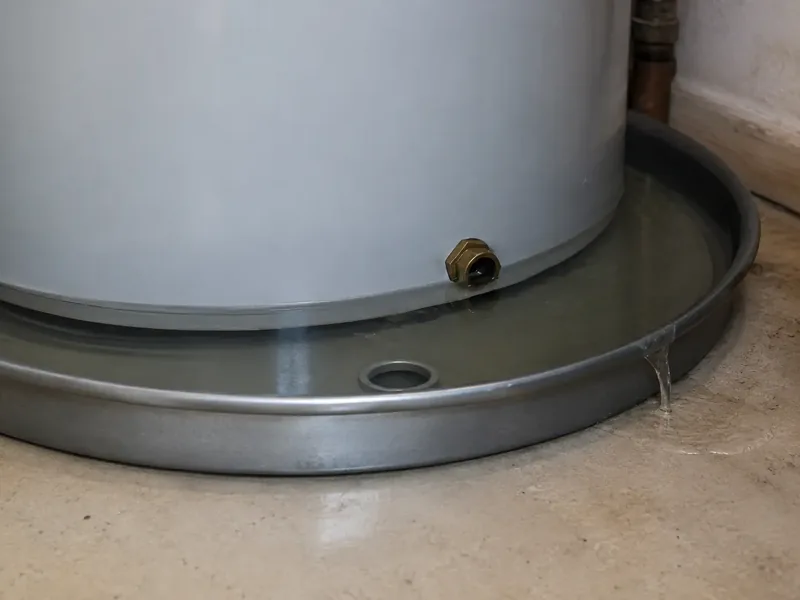
What a Water Heater Pan Actually Does
A water heater pan is a wide, shallow, rigid tray that sits directly under the water heater. Its job is to catch slow leaks, drips from fittings, relief valve discharges, and condensation, and to direct that water into a drain line instead of letting it spread across your floor. Think of the leaks a pan handles: the weeping tank seam, the dripping drain valve, the sweating fitting. These are the leaks that run for weeks unnoticed, and a pan intercepts every one of them at the source. What a pan cannot do is contain a catastrophic tank rupture; if 50 gallons let go at once, the pan overflows. But catastrophic ruptures are rare, while slow leaks are the norm, and for the leaks you are actually likely to get, a pan changes everything. Paired with a leak sensor, it turns a potential disaster into a maintenance notification. In Norton, heaters typically sit in basements, with a growing share in finished-basement utility rooms as families renovate, which is exactly the situation a proper pan is made for.
Pan Installation in Norton: Local Conditions That Shape the Job
Norton pan installs serve a college town's realities. Rental properties near Wheaton College benefit enormously from pans paired with automatic shutoff valves, because leaks in student housing get discovered late and the damage multiplies with every unattended hour. We route pan drains to floor drains or sump pits and verify the full path, since a pan that cannot drain is decoration. Family neighborhoods around the Norton Reservoir deal with variable water tables, and we plan drain terminations to avoid any route groundwater could reverse in a wet spring. As Norton families finish more basements, we increasingly install pans as part of the renovation, before drywall closes the utility area, which is the cleanest and most affordable time to do it. Newer developments get standard installs with sensor pucks, and we take the opportunity to check expansion tank pressure, since thermal expansion stress is a quiet pan-filler in closed municipal systems.
Why the Drain Line Makes or Breaks the Pan
Here is the open secret of the pan industry: most pans fail not because the pan is wrong but because the drain is. A pan with no drain is a shallow bowl; once it fills, water goes over the edge exactly as if the pan were not there. A pan with a drain that runs uphill, ties into a blocked line, or terminates where water cannot go is barely better. Our installations treat the drain as the main event. We run full-size drain piping, typically three-quarter inch minimum, with consistent pitch along the entire run, no sags, no traps that are not supposed to be there. The termination goes to a floor drain, a sump pit, or an exterior point, chosen for that specific home. We test the drain by pouring water into the pan and watching it leave, because a drain that has never been tested is a guess, not a system. For Norton homes, where heaters typically sit in basements, with a growing share in finished-basement utility rooms as families renovate, a pan with a real drain is the sensible baseline.
Pan Materials and Sizing: Getting the Details Right
Sizing a pan is not guesswork. The pan must extend at least two inches beyond the heater's footprint on all sides, because drips from top fittings fall outside the tank's diameter, and a pan that just matches the base misses them. At the same time, the pan must fit the actual space: the utility closet, the cellar nook, the clearances required around the heater for service and combustion air. We measure the heater, the space, and the path the drain must take, then choose the pan that satisfies all three. Height clearance matters as well; the pan raises the heater slightly, and in tight spaces that can affect venting connections on gas units or headroom for service. Getting this right on paper before ordering parts is what separates a professional install from a improvisation with a stock pan. That matters in Norton, because heaters typically sit in basements, with a growing share in finished-basement utility rooms as families renovate.
Sensors and Shutoffs That Watch When You Cannot
Choosing between sensor-only and sensor-plus-shutoff comes down to how your home is used. If someone is home most days and the heater sits in an unfinished basement over a floor drain, a sensor puck with an audible alarm is proportionate protection: you will hear it, walk down, and handle it. If the heater backs onto finished space, if the household is gone ten hours a day, if the property is a rental or a second home, the automatic shutoff earns its place many times over. We lay out both options with honest guidance, never pushing the upgrade where it is not warranted. Either way, the pan and drain remain the foundation; sensors and shutoffs are the alert and response layers on top. A complete installation addresses all three: contain, notify, and stop. In Norton, heaters typically sit in basements, with a growing share in finished-basement utility rooms as families renovate, so the pan, drain, and sensor earn their keep.
What Happens When You Call
Here is our standard when you dial (833) 713-2101: the right pan for the space, installed level, drained properly, sensored, and tested. No shortcuts on pitch, no drain to nowhere, no untested sensor. Our technician will show you the drain termination, demonstrate the sensor alarm, and explain the simple annual checks that keep the system reliable. For Norton, MA 02766 homes with finished basements, we will give you a straight recommendation on the automatic shutoff valve based on how the home is used, not on upsell targets. We treat your home carefully throughout, and we stand behind the workmanship. A pan installation is a small job; we treat it with the care of a big one.