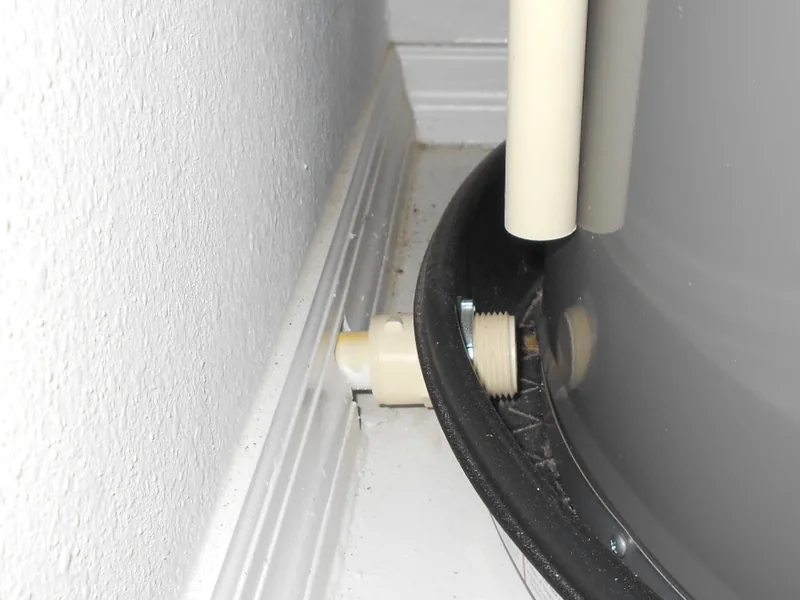
What a Water Heater Pan Actually Does
A water heater pan is a wide, shallow, rigid tray that sits directly under the water heater. Its job is to catch slow leaks, drips from fittings, relief valve discharges, and condensation, and to direct that water into a drain line instead of letting it spread across your floor. Think of the leaks a pan handles: the weeping tank seam, the dripping drain valve, the sweating fitting. These are the leaks that run for weeks unnoticed, and a pan intercepts every one of them at the source. What a pan cannot do is contain a catastrophic tank rupture; if 50 gallons let go at once, the pan overflows. But catastrophic ruptures are rare, while slow leaks are the norm, and for the leaks you are actually likely to get, a pan changes everything. Paired with a leak sensor, it turns a potential disaster into a maintenance notification. In Seekonk, heaters commonly sit in basements that double as storage, where boxes hide the first signs of a drip, which is exactly the situation a proper pan is made for.
Why the Drain Line Makes or Breaks the Pan
Choosing where the pan drains is a site-specific decision, and we make it carefully. A floor drain is ideal when one exists near the heater; the run is short and gravity does the work. A sump pit is an excellent termination in homes that have one, but we verify the pump works and the pit has capacity before relying on it, and we route so the pan drain cannot interfere with the pump's operation. Exterior termination through the foundation wall works well when interior options do not exist, but the outlet must be protected from freeze, mulch, and pests, and positioned where discharging water will not undermine the foundation or flood a walkway. What we never do is terminate a pan drain where the water has nowhere to go, or tie it into a line that could back-feed. The right termination is the one that works in the worst conditions, not just on installation day. For Seekonk homes, where heaters commonly sit in basements that double as storage, where boxes hide the first signs of a drip, a pan with a real drain is the sensible baseline.
Pan Installation in Seekonk: Local Conditions That Shape the Job
Seekonk pan installs start with access. Basements that double as storage often have the heater walled in by boxes, and a pan cannot be installed, or serviced, without clear space, so we work with homeowners to establish a permanent clear zone around the heater as part of the job. Once accessible, the install follows the proven pattern: level aluminum pan, full-size drain pitched to a floor drain, sump pit, or exterior termination, and a sensor puck placed where water will reach it first. Clay soils that slow foundation drainage argue for interior drain terminations over exterior ones in some neighborhoods. Mid-century homes with finished basements get the shutoff valve recommendation, since drywall hides leak evidence until the damage is extensive. For Seekonk's infill and newer builds, we verify that the pan drain does not share a path with anything that could back-feed, and we leave the homeowner with a simple habit: keep the heater zone clear and glance at the sensor monthly.
Pan Materials and Sizing: Getting the Details Right
Not all pans are equal, and the differences matter in a basement environment. We install rigid aluminum pans as our standard, because aluminum resists corrosion in damp basements, holds its shape under a full heater, and does not become brittle with age the way some plastics can in cold, damp conditions. Plastic pans have their place and meet code in many situations, but in the humid basements common around here, aluminum's durability wins. Galvanized steel pans exist but we avoid them; the galvanizing eventually fails in constant dampness and then the pan itself rusts. Depth matters too: a deeper pan holds more water before the drain must keep up, buying margin during a fast leak. We select the pan for the heater's footprint and the space's conditions, prioritizing fit and durability. That matters in Seekonk, because heaters commonly sit in basements that double as storage, where boxes hide the first signs of a drip.
Sensors and Shutoffs That Watch When You Cannot
A pan without a sensor is a silent guardian; it handles the water but never tells you it did. That is why every pan we install includes a leak sensor puck placed at the pan's low point, where water will reach it first. Basic sensors sound a local audible alarm, which is enough if someone is home to hear it. Smart sensors go further, sending alerts to your phone, which matters for households empty all day, frequent travelers, and rental properties. The sensor's job is simple and vital: convert a hidden leak into a notification within minutes instead of a discovery weeks later. We test every sensor at installation by wetting it, because an untested sensor is a hope, not a device. Placement matters as much as the device itself, and we position it where the pan's drainage pattern will actually deliver water to it. In Seekonk, heaters commonly sit in basements that double as storage, where boxes hide the first signs of a drip, so the pan, drain, and sensor earn their keep.
What Happens When You Call
Here is our standard when you dial (833) 713-2101: the right pan for the space, installed level, drained properly, sensored, and tested. No shortcuts on pitch, no drain to nowhere, no untested sensor. Our technician will show you the drain termination, demonstrate the sensor alarm, and explain the simple annual checks that keep the system reliable. For Seekonk, MA 02771 homes with finished basements, we will give you a straight recommendation on the automatic shutoff valve based on how the home is used, not on upsell targets. We treat your home carefully throughout, and we stand behind the workmanship. A pan installation is a small job; we treat it with the care of a big one.