How You Know It's Replacement Time
The clearest signal is a tank leaking from its shell — seam weeps, pinholes, base-seam failure with rust. That tank is structurally finished, and no repair restores it. Beyond that bright line, the decision gets more judgmental. Age is the primary factor: a conventional tank past ten to twelve years without meaningful maintenance is living on borrowed time, and every additional repair should be weighed against replacement.
Performance decline tells the story before failure does. Hot water that runs out faster than it used to, recovery that takes noticeably longer, rumbling or popping from sediment baked onto the tank bottom, rust-colored hot water, or a heater that needs frequent component repairs — each is a data point, and several together describe a unit in decline. We see homeowners pour money into a dying heater one part at a time; two or three component repairs on a twelve-year-old tank usually exceed the wisdom of replacing it once.
Efficiency is the quieter argument. A fifteen-year-old heater was built to the standards of its era; modern units heat water with meaningfully less energy, better insulation, and smarter controls. The difference shows up on every utility bill for the next decade-plus. When we discuss replacement, we include this long-view math — not as pressure, but as information, because the cheapest heater to buy is rarely the cheapest heater to own.
Sizing It Right: The Most Common Replacement Mistake
The single most common error in water heater replacement is wrong sizing, and it happens in both directions. An undersized tank leaves a family of five fighting over the last of the hot water every morning — a daily frustration that lasts the life of the unit. An oversized tank wastes energy keeping water hot that nobody uses, costs more upfront, and may not even fit the space properly.
Proper sizing starts with your household, not with what was there before. The old heater may have been wrong for the house from day one, or the household may have changed — kids grown and gone, or a new baby and a home office adding daytime demand. We ask about the number of occupants, bathrooms, and simultaneous hot-water uses (the shower running while the dishwasher fills and the washing machine runs is the real-world test), and we size the tank's first-hour rating to that demand.
For tankless sizing, the math is about flow rate and temperature rise: how many gallons per minute your household draws at peak, and how far Attleboro's cold winter incoming water — often in the 40s in January — must be raised to reach 120 degrees. That winter temperature rise is the sizing case that matters here, and it is larger than in milder climates. An undersized tankless unit is a particularly miserable mistake, delivering endless lukewarm water instead of endless hot water. We size for January, not July.
Gas, Electric, or Tankless: Choosing for Your Home
Fuel type is usually decided by what your home already has — switching fuels involves new gas lines or electrical circuits and is rarely worth it unless the existing setup is being changed anyway. Within your fuel, the tank-versus-tankless decision deserves real thought, and the right answer in southeastern Massachusetts depends on the house.
A tank heater remains the sensible default for most Attleboro homes: simple, proven, serviceable by any technician, and forgiving of the occasional neglect. In a basement that stays above freezing, a quality tank heater installed correctly is a thoroughly sound fifteen-year appliance. For households with modest hot-water demand, it is also the most economical choice over its lifetime.
Tankless earns its place for large households that empty tanks, for tight spaces where a wall-hung unit frees floor area, and for homeowners who value endless hot water and lower standby losses. But it demands more from the installation: adequate gas supply and venting, committed descaling maintenance, and — critically in New England — freeze protection for the unit and its piping. We have a dedicated tankless service practice because these units reward expertise and punish neglect; if you choose tankless, choose it with eyes open about the maintenance, and we will keep it healthy.
What Our Replacement Installation Includes
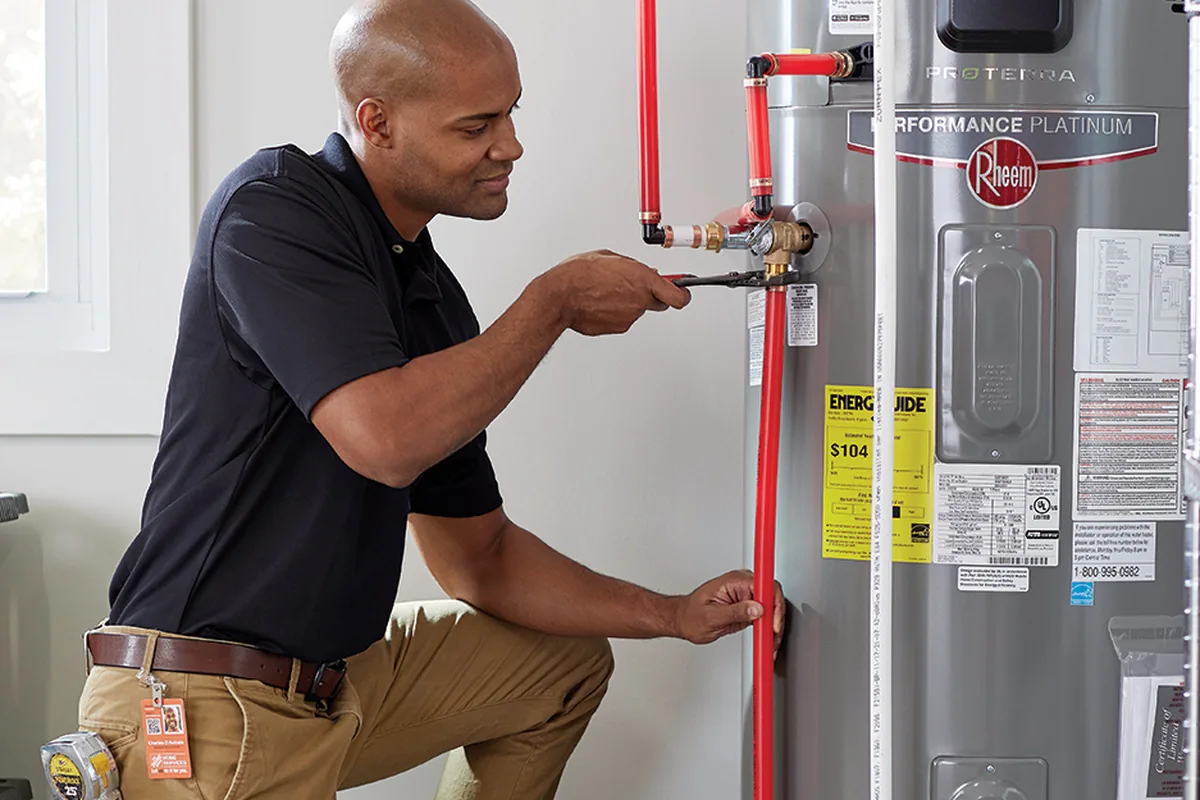
A proper replacement is more than swapping tanks, and our installations reflect that. We start by confirming the sizing and model with you before anything is disconnected — no surprises. The old unit is shut down, drained, disconnected, and hauled away; you will not be finding a dead heater in your basement for weeks.
The installation itself follows current Massachusetts plumbing standards: proper shutoff valve on the cold supply, dielectric unions where dissimilar metals meet, a new TPR valve with a correctly routed discharge pipe, an expansion tank where the plumbing system is closed, a drain pan with real drainage where the location warrants it, and proper venting for gas units verified draft-safe. Where the old installation had deficiencies — and in Attleboro's older homes it often does — we correct them rather than inheriting them: seized shutoffs get replaced, corroded connections get renewed, improper discharge piping gets fixed.
Commissioning is the step that separates professional installation from a mere swap. We fill the tank completely and purge all air before power or gas is restored — dry-firing an electric element is an instant casualty we never risk. Gas connections are leak-tested at every joint. The burner or elements are verified through a full heating cycle, the thermostat is set to 120 degrees, and we confirm hot water at your taps before we consider the job complete. Then we walk you through the new unit: the shutoffs, the TPR test lever, the maintenance schedule, and what to watch for.
Timing It on Your Schedule Instead of the Tank's
The best replacement is a planned one. A heater replaced at eleven years on a calm Tuesday is a straightforward half-day job with time to choose the right unit; a heater replaced at 2 a.m. after rupturing is an emergency with whatever unit can be sourced fastest. If your heater is approaching the end of its expected life — past ten years, never serviced, showing any of the decline signs described above — a planned replacement puts you in control of the timing, the model selection, and the cost.
We offer pre-replacement assessments for exactly this situation: we evaluate your heater's real condition — tank integrity, anode rod state, component health, installation deficiencies — and give you an honest forecast. Sometimes the verdict is 'this has years left, keep maintaining it'; sometimes it is 'plan for next spring.' Either way, you are deciding rather than reacting.
Seasonal timing matters too. Replacing in fall means the new unit — with its fresh anode rod, clean tank, and verified safety systems — heads into the hardest heating season in peak condition. Replacing in the depths of January means doing the job under emergency conditions. If your heater is aging and autumn is approaching, call (833) 713-2101 for an assessment. Future you, ankle-deep in a February basement, will be grateful.
What Happens to the Old Heater
Every replacement includes removal and responsible disposal of the old unit — drained, disconnected, and hauled away the same day. Steel tanks are recyclable, and we see that they go to scrap recycling rather than a landfill. You are left with a clean installation area, not a project.
We also take the opportunity the empty space provides: with the old heater out, we can see the floor beneath it, the condition of the surrounding plumbing, and the state of shutoff valves that were previously inaccessible. If we find issues — a deteriorated floor section, a seized main shutoff, supply piping that should be renewed — we tell you while the access is open and the incremental work is cheapest.
Before we leave, the walkthrough covers everything you need to own the new heater confidently: where the shutoffs are and how to use them, how to test the TPR valve, what the maintenance schedule looks like (anode rod checks, flushing, and for tankless units descaling), and the warning signs that merit a call. A new water heater should give you a decade or more of quiet service — our job is to install it right and set you up to keep it that way. Call (833) 713-2101 to discuss your replacement.