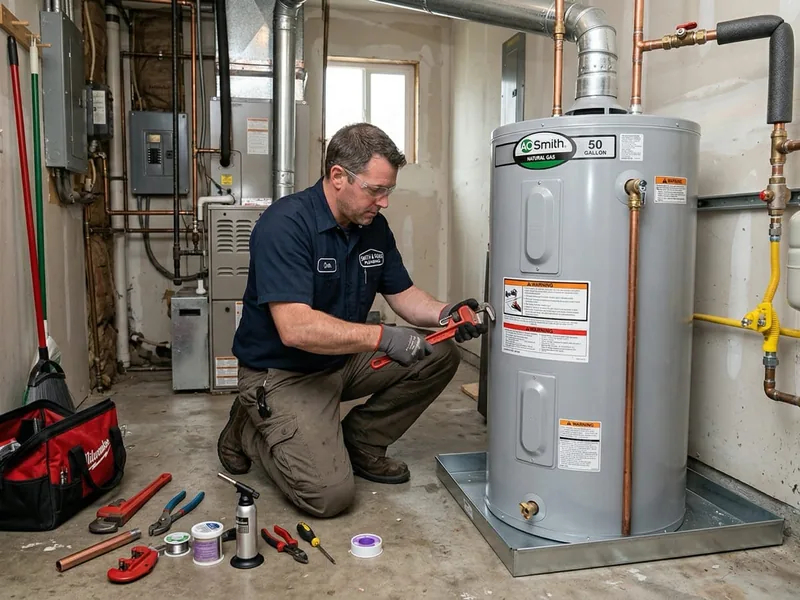
Signs It Is Time to Replace, Not Repair
Age is the first indicator, and it is the most honest one. Conventional tank water heaters typically serve 8 to 12 years; past that, internal corrosion is progressing whether you can see it or not. If your unit is in that range and showing any other symptom, replacement planning should start now, on your schedule. The symptoms that confirm the diagnosis: rusty or discolored hot water, which means the anode rod is gone and the tank steel is corroding; rumbling or popping during heating, which means sediment has built up and is overheating the tank bottom; moisture or rust at the tank base, which often means the steel has already failed; and declining capacity, where the heater runs out faster than it used to. Any one of these in an aging unit points to replacement. A tank that is leaking from the seam or wall cannot be repaired; that decision is made for you. In Attleboro, heaters usually sit in basements, sometimes tucked behind finished walls where a slow leak can run for weeks unnoticed, making correct sizing and installation details matter.
Replacing a Water Heater in Attleboro: Local Realities
Attleboro replacements often involve heaters that have served well past their prime. Mill-era and post-war homes hold a large population of tanks in the 12-to-20-year range, and when we arrive for a replacement we usually find the old unit has been weeping from a seam for months, hidden behind a finished basement wall. The swap itself needs planning in these homes: narrow basement stairs, tight turns, and old installations with rigid piping that has to be carefully cut back. We measure doorways and stairwells before the new unit arrives, and we bring the right equipment to move a 150-pound tank without damaging finished surfaces. Attleboro's mix of gas and electric service means fuel decisions are genuinely open for many homeowners, and we walk through tank, tankless, and heat pump options against the home's actual hot water use. The Ten Mile River humidity also argues for addressing ventilation and condensate routing properly on the new install, not just swapping the box.
Getting the Size Right Matters More Than the Brand
Undersizing and oversizing both punish you, in different ways. An undersized heater runs out during the morning rush, recovers slowly, and works its components harder, shortening its life. An oversized heater means a bigger upfront investment and higher daily energy use keeping a big tank hot around the clock, and in some cases short-cycles in ways that stress controls. The right size lives in the middle, matched to measured demand. For tankless units, sizing shifts to flow rate: gallons per minute at your groundwater temperature rise, which in Massachusetts winters is a significant lift. We calculate this honestly, because an undersized tankless that cannot handle two showers in January is a expensive disappointment. Heat pump models bring their own sizing logic around recovery rate and ambient temperature. Whatever the technology, the math comes before the model selection, not after. For Attleboro homeowners, where heaters usually sit in basements, sometimes tucked behind finished walls where a slow leak can run for weeks unnoticed, a planned replacement beats an emergency every time.
Tank, Tankless, or Heat Pump: Choosing Honestly
Heat pump, or hybrid, water heaters are the efficiency leaders, moving heat from the surrounding air into the water rather than generating it directly. In the right setting, they use dramatically less energy than conventional electric tanks. The right setting matters: they need ambient warmth and space, performing strongly in basements that stay above about 40 degrees, and they cool and dehumidify the surrounding air, which is a bonus in damp basements and a consideration in cold ones. They are taller than conventional tanks, need condensate drainage, and operate with a gentle hum. For all-electric homes with suitable basements, they are often a strong long-term value despite higher upfront investment. We evaluate your basement's temperature profile and space honestly before recommending one, because the wrong setting negates the advantages. That is the reality in Attleboro, where heaters usually sit in basements, sometimes tucked behind finished walls where a slow leak can run for weeks unnoticed.
Your Replacement, Start to Finish
The details around the tank are what separate a complete installation from a swap. Every replacement we do includes an expansion tank where the plumbing system requires it, because thermal expansion in a closed system will otherwise weep the relief valve and stress every joint. We install full-port serviceable shutoffs on the water lines, so any future service does not require shutting down the house. Dielectric unions go where dissimilar metals meet, preventing the galvanic corrosion that killed the old connections. The temperature-pressure relief valve gets a new, properly rated valve with discharge piping routed to a safe, visible termination, full-size, no threads on the end, terminating where you can see it. A drain pan with a real drain path and a leak sensor goes under every unit where a leak could cause damage. These are not upgrades; they are the job done completely. In Attleboro, heaters usually sit in basements, sometimes tucked behind finished walls where a slow leak can run for weeks unnoticed, so getting the replacement right the first time pays off.
What Happens When You Call
When you call (833) 713-2101 about a replacement, here is the process. We start with an assessment: the age and condition of your current heater, your household's hot water demand, and your home's fuel service, space, and venting. Then we give you straight guidance on repair versus replace, and if replacement is the answer, honest equipment options across tank, tankless, and heat pump models with the trade-offs of each. On installation day, we protect your home, remove the old unit, install the new one completely with expansion control, proper venting, relief discharge, pan, and sensor, then commission and test everything. Serving Attleboro, MA 02703, we leave you with reliable hot water and clear care instructions. One call starts it: (833) 713-2101.