Tank, Tankless, or Heat Pump: Choosing Honestly
The fuel question underlies the type question. Homes with natural gas service have the widest options and typically the lowest running expense for tank and tankless units. All-electric homes choose between conventional electric tanks and heat pump models, with the heat pump winning on running expense where the setting suits. Oil-fired indirect systems, where the boiler heats domestic water, are a separate category common in older Massachusetts homes; we evaluate whether the boiler setup still makes sense or whether a standalone unit serves better. We do not push fuel conversions casually, since they involve real infrastructure work, but where the existing setup is failing or inefficient, we lay out the conversion path honestly. The right answer is always specific to your home's service, space, and usage, never a one-size pitch. In Raynham, heaters in newer developments sit in clean utility rooms, while older capes keep them in low crawlspaces, making correct sizing and installation details matter.
Your Replacement, Start to Finish
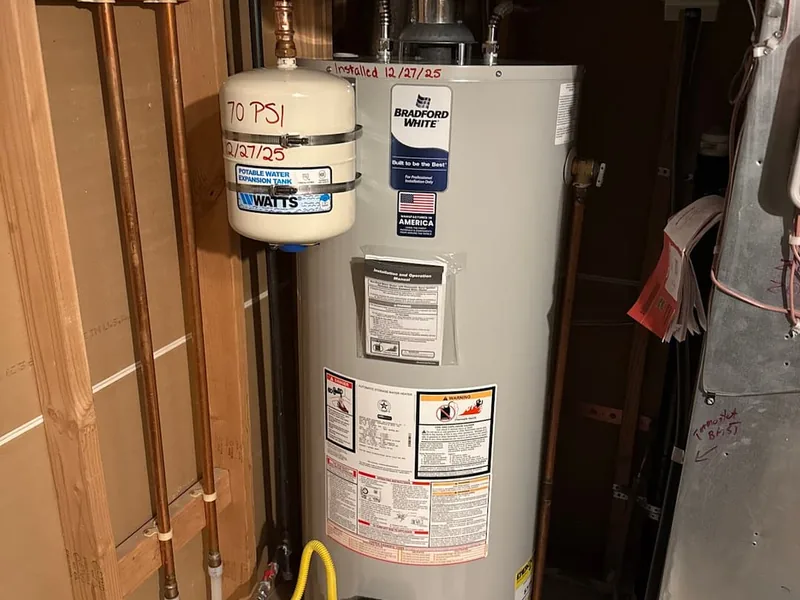
The details around the tank are what separate a complete installation from a swap. Every replacement we do includes an expansion tank where the plumbing system requires it, because thermal expansion in a closed system will otherwise weep the relief valve and stress every joint. We install full-port serviceable shutoffs on the water lines, so any future service does not require shutting down the house. Dielectric unions go where dissimilar metals meet, preventing the galvanic corrosion that killed the old connections. The temperature-pressure relief valve gets a new, properly rated valve with discharge piping routed to a safe, visible termination, full-size, no threads on the end, terminating where you can see it. A drain pan with a real drain path and a leak sensor goes under every unit where a leak could cause damage. These are not upgrades; they are the job done completely. For Raynham homeowners, where heaters in newer developments sit in clean utility rooms, while older capes keep them in low crawlspaces, a planned replacement beats an emergency every time.
Signs It Is Time to Replace, Not Repair
The repair-versus-replace question has a clear framework. Repair makes sense when the heater is relatively young and the problem is a component: a failed heating element, a faulty thermostat, a weeping fitting, a tired relief valve. These are serviceable parts, and fixing them restores the unit. Replacement makes sense when the tank itself is compromised, when the unit is past its expected service life, or when repairs are stacking up on an aging heater. There is also the efficiency angle: a 15-year-old heater with heavy sediment uses noticeably more energy than a modern unit, so replacement pays back through lower energy use as well as reliability. We assess honestly and tell you which side of the line your heater is on, because recommending a repair that fails in six months helps no one. That is the reality in Raynham, where heaters in newer developments sit in clean utility rooms, while older capes keep them in low crawlspaces.
Replacing a Water Heater in Raynham: Local Realities
Raynham replacements must respect the water table. In neighborhoods near the Taunton River lowlands, we elevate the new heater on a sturdy, corrosion-resistant stand, breaking the cycle where the old unit sat in seasonal dampness and rusted from the bottom up. Pan drainage gets routed to interior points that high groundwater cannot reverse. Older capes with heaters in low crawlspaces need equipment chosen for the space: low-profile dimensions, accessible service points, and condensate handling that works by gravity or pump as the site requires. Newer developments get standard modern installs with full attention to sizing, since growing families often need more first-hour capacity than the builder-grade original provided. Route 44 corridor homes with finished basements get the protection package with the replacement: pan, sensor, and automatic shutoff valve installed together. Every Raynham replacement ends commissioned and tested, with maintenance basics covered.
Getting the Size Right Matters More Than the Brand
The most common sizing mistake is copying the old tank's size. Households change: kids grow, bathrooms get added, laundry moves indoors, home offices mean daytime hot water use that did not exist before. We size from your household's actual demand, starting with the first-hour rating, which measures how much hot water the heater can deliver in a busy hour, not just the tank's storage volume. A 50-gallon tank with a strong burner can outperform a larger tank with a weak one during the morning rush. We ask about your real patterns: simultaneous showers, back-to-back laundry, dishwasher timing, and any plans like a new bathroom. The goal is a heater that covers your peak hour with margin, without being so oversized that it short-cycles and wastes energy. Right-sizing is the single biggest determinant of whether you will be happy with the new unit. In Raynham, heaters in newer developments sit in clean utility rooms, while older capes keep them in low crawlspaces, so getting the replacement right the first time pays off.
What Happens When You Call
When you call (833) 713-2101 about a replacement, here is the process. We start with an assessment: the age and condition of your current heater, your household's hot water demand, and your home's fuel service, space, and venting. Then we give you straight guidance on repair versus replace, and if replacement is the answer, honest equipment options across tank, tankless, and heat pump models with the trade-offs of each. On installation day, we protect your home, remove the old unit, install the new one completely with expansion control, proper venting, relief discharge, pan, and sensor, then commission and test everything. Serving Raynham, MA 02767, we leave you with reliable hot water and clear care instructions. One call starts it: (833) 713-2101.